Showing posts with label africa. Show all posts

Exploration of Africa

Exploration of Africa

Systematic exploration of Africa by Europeans began with James Bruce, who was born at Kinnaird in Scotland in 1730. After a century of bloody internal war, Scottish energy turned to intellectual and scientific studies, including exploration.

Bruce arrived in Algiers in 1762 as the British consul, and in 1768 he was in Cairo, where he conceived the great dream of his life: to find the source of the Nile River. Unlike others, Bruce believed the source of the Nile was in Ethiopia.

Bruce had the misconception that the Blue Nile was the main point of origin of the great river, not the White, as later explorers would determine. Indeed, the White and Blue Niles are two distinct rivers, as explorers would later learn.


Bruce, with self-confidence and determination, was the prototype of the African explorer. In November 1770 he reached Ethiopia’s Lake Tana, the source of the Blue Nile. After months of adventure and war, he returned to Cairo in January 1773 before going on to London and then to his native Scotland.

In 1790 he published the record of his journeys, Travels to Discover the Sources of the Nile. Four years later, Bruce, who had survived disasters and dangers, died at home from a fall on a flight of steps.

The next great explorer of Africa was another Scotsman, Mungo Park, born in Selkirkshire in 1771. In 1789 he went to Edinburgh to study to become a surgeon. Park’s extraordinary abilities caught the attention of Joseph Banks, perhaps the greatest botanist of his day.

After Park completed his studies, Banks helped him secure the position of surgeon on the British East India Company’s merchant ship Worcester. When he returned, he brought descriptions of eight new species of fish. Meanwhile, French and British colonial rivalry was beginning to engulf Africa.

Impressed by Park’s presentation of the new species, Banks recommended Park as a scientist for the Association for the Promotion and Discovery through the Interior of Africa—an expedition-sponsoring association.

He got the position, and the expedition set sail on May 22, 1795. The party located the Niger River on July 22, 1796, and Park’s record of the journey was published in 1799 as Travels in the Interior Districts of Africa.

In January 1805 Park set sail in the troopship HMS Crescent and landed at the port of Gorée on the Gambia two months later. Disregarding sickness and bandits, which took a steady toll of his party, Park reached the Niger on August 19. Park wrote his last letter to his wife, Allison, on November 20, 1805. It appears the Scotsman was killed in a skirmish with tribesmen at Bussa Falls in 1805 on the Niger.

The Napoleonic conquest of Egypt guaranteed continued British interest in Africa because it brought the continent into the heart of the conflict. One of Napoleon’s generals, Louis-Charles-Antoine Desaix, unwittingly became one of the first European explorers of the Nile as he pursued the defeated Mamluks into Upper Egypt. The British used the Napoleonic Wars to stake their claim on South Africa as well.

In 1806 at the southern extremity of the continent, the British seized the Dutch colony at what would become Cape Town, since the Netherlands were then allied with the French. The great anchorage of Table Bay made the site vital to communications with the crown jewel of the growing British Empire, India.

It became the southern British gateway to the interior of Africa, then undergoing the imperial conquests of the Zulu king Shaka Zulu. From Cape Town came the British penetration of the southern half of Africa that continued to the end of the 19th century.

Cape Town

In November 1810 the new British colony of Cape Town led to the first British journey into the unknown Bantu lands to the north. William Burchell was born in 1782, the son of a professional nurseryman. Like Joseph Banks and Mungo Park before him, an interest in botany led to his interest in exploration.

It took Burchell several months to gather together an expedition. His goal was the Kalahari Desert and Angola, which the Portuguese had first visited in the 15th century in their long trek down the west coast of Africa.

Discovering the desert, the terrible heat and lack of water finally forced Burchell to abandon his quest for Angola, and in August he turned back. It would take him and his party two and a half years to return to Cape Town, having traversed some of the most forbidding terrain in Africa.

In April 1815 he returned to Cape Town with an immense scientific treasure from his years of exploration. He returned to England, and from 1822 to 1824 Burchell devoted himself to writing his two-volume Travels in the Interior of Southern Africa.

Thus, by the end of the Napoleonic Wars in 1815, much of the coastal area of Africa had been explored, and intrepid adventurers had begun to enter the uncharted heart of the continent. For the rest of the century, the lure of the African interior would be irresistible.

While governments may have had their own agendas, for the great majority of explorers, they traveled neither for imperial glory or monetary gain, but for the sheer adventure of finding out what lay beyond the next river or mountain range.

Still, as in the era of Mungo Park, one of the greatest challenges to exploration was the ancient city of Timbuktu; this and the source of the Nile formed two of the Holy Grails for generations of explorers.

In May 1825 Alexander Gordon Laing landed in Tripoli, determined to find his way to Timbuktu. Finally, after a year of incredible hardship in the desert, on August 13, 1826, he arrived at Timbuktu.

Although the city disappointed him, Laing was impressed by the Mosque of Sankore, built by the great Muslim West African ruler Mansa Musa. Although Laing had achieved his goal, his exploration ended in tragedy.

On September 21, 1826, Laing was told he was not safe and left the city to walk into a trap set by Sheikh Ahmadu El Abeyd, who had promised him protection. On September 22 El Abeyd demanded Laing accept Islam, but the Scotsman refused. He was killed and his head cut off.

Zanzibar

The chapter in the history of African exploration concerning Richard Burton and John Hanning Speke is the most tragic of all. In 1856 Richard Burton, perhaps the greatest British adventurer of his generation, was commissioned by the Royal Geographic Society to find the source of the Nile.

He decided to take with him a companion from an earlier expedition, John Hanning Speke. Burton was already an accomplished traveler, proficient in Arabic, and able to carry off pretending to be a Muslim.

On December 19, 1856, Burton and Speke arrived at Zanzibar from Bombay, where Burton held a commission in the army of the East India Company. Both men took ample time in Zanzibar preparing for their expedition.

They set off on their quest after years of travels and squabbles. Burton was convinced that Lake Tanganyika was the source of the White Nile, whereas Speke believed it was Lake Ukewere, which he renamed Lake Victoria.

The rivalry that began in their prior expedition came to a head, and when Burton stopped to rest in Aden, Speke went on to England, promising to wait for his return to reveal the results of their journeys. He broke that promise, and by the time Burton arrived in England on May 21, 1858, Speke had convinced the Royal Geographic Society that Lake Victoria was the source.

This accomplishment earned him another commission by the society, and he did not invite Burton to join him on his return to Africa to verify the claim. Instead, Speke chose an army companion, James Augustus Grant. They arrived in Zanzibar from England in August 1860. They retraced the route that Speke had taken with Burton.

After several months in Uganda, Speke and Grant continued their trip. Because Grant had a severely infected leg, Speke tended to forge ahead on his own. On July 21, 1862, Speke found himself on the Nile and on July 28 came to Rippon Falls, where the White Nile flows out of Lake Victoria.

It was during Speke’s second trip that he and Grant met two of the period’s most colorful explorers, Samuel Baker and his redoubtable wife, Florence. They met Speke at Gondokoro on the White Nile, whose source the Bakers were pursuing. A question remained about another lake, known as the Luta N’zige.

Speke believed that the White Nile flowed into it from Lake Victoria and then out of Luta N’zige. Speke suggested to Baker that he take up the investigation, and Baker was pleased to do so. On February 26, Speke and Grant resumed their journey down the Nile to Khartoum, and from there to Cairo and England.

Lake Albert

The Bakers continued with their exploration and on January 31, 1864, they struck out on the final march toward Luta N’zige. On March 15, 1864, they found the lake, which they renamed Lake Albert.

Samuel explored the surrounding area and saw that the Nile flowed through it. He and Florence returned to England in October, and Samuel was given a gold medal by the Royal Geographic Society. The following August he was knighted.

Meanwhile Speke returned to England without any convincing evidence that his theory was correct. The British Association for the Advancement of Science set up a meeting between Burton and Speke to make their cases.

At a preliminary meeting Burton triumphed over Speke. On September 15, one day before the final confrontation, Speke was shot dead while hunting. Many claimed he had shot himself by accident, but others felt he had taken his own life.

Throughout this entire period the name David Livingstone seemed to dominate. Livingstone was a Scotsman born on May 1, 1813. He first visited Africa as a missionary, having gained a degree in medicine at the age of 25 at the University of Glasgow.

Livingstone soon realized that the exploration of this virtually unknown continent was more to his heart than laboring at a missionary station and devoted himself to exploration, often with his wife.

On June 1, 1849, with two companions, Orwell and Murray, he traveled to find Lake Ngami, and on August 1 Livingstone and his party sailed down the entire lake. Then began Livingstone’s exploration of the Zambezi River.

A national hero back home, Livingstone recounted his travels in his best-selling Missionary Travels and Researches in South Africa. From 1858 to 1864 he was in Africa on a second expedition to explore eastern and central Africa. He returned to Africa in 1864 to look for the sources of the Nile.

Striking out from Mikindani on the east coast, the expedition was forced south, and some of his followers deserted him, concocting the story that he had been killed and making headline news. Livingstone, however, pressed on, reaching Lakes Mweru, Bangweulu, and Tanganyika. Moving on to the Congo River, he went farther than any European before him.

It was on this exploration that rumors reached England and North America that the great explorer was near death. In 1869 the New York Herald hired Henry Morton Stanley to find Dr. Livingstone.

On November 10, 1871, Stanley found Livingstone at his camp at Ujji on Lake Tanganyika. Upon Livingstone’s death in 1873, his body was returned to England for burial in Westminster Abbey. Stanley decided to pick up where Livingstone, Burton, and Speke had left off, and he set off on his own expedition.

The most important result of the journey was the realization that Speke’s theory had been right—Lake Victoria was the source for the White Nile. He followed the Congo River and caught the attention of King Leopold II of Belgium, who wished to develop the Congo River basin. In 1879 Stanley set off for Africa in the service of Leopold.

The exploration of Africa led to a rivalry among the countries that had sponsored the explorers. At the same time that Stanley had been exploring the Congo for Belgium, so had Pierre Savorgnan de Brazza for France.

To prevent an African rivalry from endangering the peace of Europe, Chancellor Otto von Bismarck of Germany chaired a Conference of Berlin from November 1884 to February 1885 to gain the Great Powers’ agreement to a peaceful partition of Africa.

The map of Africa was filling in as the end of the century approached. The areas not yet mapped quickened the heartbeats of explorers from all over the world. Kenya was the next area of interest. On January 2, 1887, the Hungarian explorer Count Teleki von Szek arrived in Zanzibar with Ludwig von Hohnel.

Their goal was to explore for their patron, Crown Prince Rudolph of Austria-Hungary, another of the lakes that still tantalized African explorers, known in the local language as Basso Narok, or Black Water. Teleki was the first to climb Mount Kenya before discovering two more lakes, today known as Turkana and Stefanie.

On October 26, 1888, after close to two years, they returned to Mombasa and the voyage home. Sixteen years later, in 1914, World War I changed the map of Africa forever. Still, in honor of the explorer who had the purest heart, in spite of the era of decolonization after World War II and the years of unrest that followed, the statue of Dr. David Livingstone still stands overlooking Victoria Falls today.

Imperialism and the Partition of Africa

Imperialism and the Partition of Africa

Imperialism, or the extension of one nation-state’s domination or control over territory outside its own boundaries, peaked in the 19th century as European powers extended their holdings around the world.

The huge African continent (three times the size of the continental United States) was particularly vulnerable to European conquest. The partition of Africa was a fast-moving event. In 1875 less than one-tenth of Africa was under European control; by 1895 only one-tenth was independent.

Between 1871 and 1900 Britain added 4.25 million square miles and 66 million people to its empire. British holdings were so far-flung that many boasted that the “sun never set on the British Empire.” During the same time frame, France added over 3.5 million square miles of territory and 26 million people to its empire.


Controlling the sparsely populated Sahara, the French did not rule over as many people as the British. By 1912 only Liberia and Ethiopia in Africa remained independent states, and Liberia was really a protectorate of U.S.-owned rubber companies, particularly the Firestone Company.

By the end of the 19th century, the map of Africa resembled a patchwork quilt of different colonial empires. France controlled much of North Africa, West Africa, and French Equatorial Africa (unified in 1910). The British held large sections of West Africa, the Nile Valley, and much of East and southern Africa.

The Spanish ruled small parts of Morocco and coastal areas along the Atlantic Ocean. The Portuguese held Angola and Mozambique, and Belgium ruled the vast territories of the Congo. The Italians had secured Libya and parts of Somalia in East Africa. Germany had taken South-West Africa (present-day Namibia), Tanganyika (present-day Tanzania), and Cameroon.

Britain had the largest empire and the French the second largest, followed by Spain, Portugal, and Belgium. Germany and Italy, among the last European nations to unify, came late to the scramble for Africa and had to content themselves with less desirable and lucrative territories.

There were many different motivations for 19thcentury imperialism. Economics was a major motivating factor. Western industrial powers wanted new markets for their manufactured goods as well as cheap labor; they also needed raw materials.

J. A. Hobson and Vladimir Lenin both attributed imperial expansion to new economic forces in industrial nations. Lenin went so far as to write that imperialism was an inevitable result of capitalism.

As the vast mineral resources of Africa were exploited by European imperial powers, many Africans became laborers in mines or workers on agricultural plantations owned by Europeans. The harsh treatment or punishment of workers in the rubber plantations of the Belgian Congo resulted in millions of deaths.

However, economics was not the only motivation for imperial takeovers. In some instances, for example the French takeover of landlocked Chad in northern Africa, imperial powers actually expended more to administer the territory than was gained from raw materials, labor, or markets.

Nationalism fueled imperialism as nations competed for bragging rights over having the largest empire. Nations also wanted control over strategic waterways such as the Suez Canal, ports, and naval bases. Christian missionaries traveled to Africa in hopes of gaining converts.

When they were opposed or even attacked by Africans who resented the cultural incursions and denial of traditional religions, Western missionaries often called on their governments to provide military and political protection.

Hence it was said that “the flag followed the Bible.” The finding of the Scottish missionary David Livingstone by Henry Stanley, an American of English birth, was widely popularized in the Western press. Livingstone was not actually lost, but had merely lost contact with the Western world.

Explorers, adventurers, and entrepreneurs such as Cecil Rhodes in Rhodesia and King Leopold II of Belgium, who owned all of the Congo as his personal estate, also supported imperial takeovers of territories.

Richard Burton, Samuel and Florence Baker, and John Speke all became famous for their exploration of the Nile Valley in attempts to find the source of that great river. Their books and public lectures about their exploits fueled Western imaginations and interest in Africa.

Cultural Imperialism

Cultural imperialism was another important aspect of 19th-century imperialism. Most Westerners believed they lived in the best possible world and that they had a monopoly on technological advances.

In their imperial holdings, European powers often built ports, transportation, communication systems, and schools, as well as improving health care, thereby bringing the benefits of modern science to less developed areas.

Social Darwinists argued that Western civilization was the strongest and best and that it was the duty of the West to bring the benefits of its civilization to “lesser” peoples and cultures.

Western ethnocentrism contributed to the idea of the “white man’s burden,” a term popularized by the poet Rudyard Kipling. Racism also played a role in Western justifications for imperial conquests.

European nations devised a number of different approaches to avoid armed conflict with one another in the scramble for African territory. Sometimes nations declared a protectorate over a given African territory and exercised full political and military control over it. At other times they negotiated through diplomatic channels or held international conferences.

At the Berlin Conference of 1884–85, 14 nations decided on the borders of the Congo that was under Belgian rule, and Portugal got Angola. The term spheres of influence, whereby a nation declared a monopoly over a territory to deter rival imperial powers from taking it, was first used at the Berlin Conference.

However, disputes sometimes led European nations to the brink of war. Britain and France both had plans to build a north-south railway and east-west railway across Africa; although neither railway was ever completed, the two nations almost went to war during the Fashoda crisis over control of the Sudan, where the railways would have intersected.

Britain was also eager to control the headwaters of the Nile to protect its interests in Egypt, which was dependent on the Nile waters for its existence. Following diplomatic negotiations the dispute was resolved in favor of the British, and the Sudan became part of the British Empire.

War did break out between the British and Boers over control of South Africa in 1899. By 1902 the British had emerged victorious, and South Africa was added to their empire. In West Africa, European powers carved out long narrow states running north to south in order that each would have access to maritime trade routes and a port city.

Since most Europeans knew little or nothing about the local geography or demographics of the region, these new states often separated similar ethnic groups or put traditional enemies together under one administration. The difficulties posed by these differences continue to plague present-day West African nations such as Nigeria.

French and British Rule

The French and British adopted very different approaches to governance in their empires. The French believed in their “civilizing mission” and sought to assimilate the peoples of their empire by implanting French culture and language.

The British adopted a policy of “indirect rule.” They made no attempt to assimilate the peoples of their empire and educated only a small number of Africans to become civil servants. A relatively small number of British soldiers and bureaucrats ruled Ghana and Nigeria in West Africa.

In East Africa, the British brought in Indians to take jobs as government clerks and in commerce. Otherwise, the British tried to avoid interfering with local rulers or ways of life. Although the British and French policies were radically different, both were based on the belief in the superiority of Western civilization.

European colonists also settled in areas where the climate was favorable and the land was suitable for agriculture. Substantial numbers of French colons settled in the coastal areas of North Africa, especially in Algeria and Tunisia, while Italians settled in Tunisia and Libya.

British settlers moved into what they named Rhodesia and Kenya. In Kenya, British farmers and ranchers moved into the highlands, supplanting Kenyan farmers and taking much of the best land.

The Boers, Dutch farmers, fought the Zulus for control of rich agricultural land in South Africa. The Boers took part in a mass migration, or Great Trek, into the interior of South Africa from 1835–41 and established two independent republics, the Orange Free State and the Transvaal.

Dutch farmers clashed with the British for control of South Africa in the Boer War. In Mozambique and Angola, Portuguese settlers (prazeros) established large feudal estates (prazos). Throughout Africa, European colonists held privileged positions politically, culturally, and economically. They opposed extending rights to native African populations.

A few groups, such as the Igbos in Nigeria and the Baganda in Uganda, allied with the British and received favored positions in the colonial administrations. However, most Africans resisted European takeovers.

Muslim leaders, such as Abdul Kader in Algeria and the Mahdi in Sudan, mounted long and effective armed opposition to French and British domination. But both were ultimately defeated by superior Western military strength.

The Ashante in Ghana and the Hereros in South-West Africa fought against European domination but were crushed in bloody confrontations. The Zulus led by Shaka Zulu used guerrilla warfare tactics to halt the expansion of the Boers into their territories, but after initial defeats the Boers triumphed.

The Boers then used the hit-and-run tactics they had learned from the Zulus in their war against the British. The British defeated the Matabele and Mashona tribes in northern and southern Rhodesia. In the 20th century, a new generation of nationalist African leaders adopted a wide variety of political and economic means to oppose the occupation of their lands by European nations and settlers.

Portuguese Colonies in Africa

Portuguese Colonies in Africa

Before the 1880s most African societies were independent of European rule. With particular reference to Africa south of the Sahara, colonial rule was confined to coastal patches and the Cape region, the latter being home to Anglo-Boer political rivalry.

As regards the Portuguese, their colonial interest was restricted to their colonies of Angola, Mozambique, and the tiny area of Portuguese Guinea. Interestingly, Portuguese rule in these areas was not strong. The reason was that trade, not political administration, dominated the purpose of their encounter with Africans during this period.

It was because of this that no major political responsibility was taken by Portugal, unlike the other European powers, with regard to colonies in Africa, creating the unique nature of Portuguese enterprise or activities in Africa between 1750 and 1900.


The establishment of colonies and colonial rule, as well as the strategies employed by the Portuguese to keep their holdings in Africa, have an interesting history, despite their dwindling fortunes during this period, occasioned by economic, political, and strategic factors.

Portuguese Enterprise

Between 1750 and 1900 the Portuguese did not achieve much as far as their attempt to establish colonial rule in Africa was concerned. But if colonialism is taken to mean the occupation and control of one nation by another, then some of the attempts made by Portugal to establish political control over some parts of Africa can be highlighted as examples.

It is important to stress that the driving force behind Portuguese enterprise in Africa, and elsewhere in the world, was trade and economic exploitation of their colonies, and it is this more than anything that drove Portuguese desire for political control of these areas.

Indeed, Portugal, like many of the other colonial powers, had always treated its colonies like private estates of the motherland, where resources had to be repatriated for the development of the latter.

No real political administration and structure were put in place in the colonies. In the case of East Africa, the area was more or less a stopping place for the Portuguese on their way to Asia. The chief result of their rule in this region was that it contributed greatly to crippling the old Arab settlements that were once the pride of the East African coast.

Portugal viewed its East African possessions with mixed feelings. While the area did not give them the wealth they had expected, they nevertheless wanted to contain Arab influence in the area and deal directly with the indigenous Africans. It was for this that the Portuguese attacked communities in the area and established a presence in Mombasa, Sofala, Kilwa, Mozambique, and Pemba.

There were many obstacles as far as its East African project was concerned. First, many of the Portuguese settlers in East Africa died from tropical diseases. Many others were killed in the continual fighting on the coast.

Second, due in large part to disease and fighting, Portugal never had a population large enough to carry out its colonial plans in East Africa. Most of its personnel were kept busy in Brazil and their empire in the Indian Ocean.

Third, competition from the British and the Dutch East India Company helped to weaken the Portuguese hold on the eastern shores of the Indian Ocean.

Then there were numerous revolts from the Arab leaders of the region. For instance, in 1698 Sultan bin Seif, the sultan of Oman, and his son, Imam Seif bin Sultan, captured Fort Jesus, which had been the military and strategic base of Portuguese holdings in East Africa.

Indeed, in 1699 the Portuguese were driven out of Kilwa and Pemba, thus marking the end of Portuguese colonial interest in East Africa north of Mozambique. Earlier in 1622 a revolt against the Portuguese led by a former Portuguese mission pupil, Sultan Yusuf, helped to prepare the disintegration of Portuguese military strength in Mombasa.

Consequent upon these issues, Portuguese holdings in East Africa were far from a successful colonial rule. By 1750 Portuguese interests in East Africa were replaced by a new socio-political order led by the leaders of Oman.

African Interior

In the interior of Africa, the Portuguese did not achieve anything substantial as far as colonial rule was concerned. The Mwenemutapa (known to the Portuguese as Monomotapa) did not provide fertile soil for the establishment of Portuguese colonization.

The Portuguese, for their part, were more interested in what they would get instead of what they would give. Besides, the area was already experiencing decline owing to the emergence of several dynasties in the region. This situation was not helped by contact with the Portuguese.

Elsewhere, in Guinea there was Portuguese influence, but it was not enough to be described as colonial rule. By 1750 Portuguese colonies in Africa were limited to Angola, Mozambique, and Guinea, but colonial rule was more pronounced in the first two colonies. The Portuguese also held important islands in the Atlantic off the coast of Africa.

During this period Portuguese colonies, especially Angola, remained the supply base for the Brazilian slave trade. The Portuguese sought to create a highly polished elite conditioned by their culture. This aspiration did not materialize.

Indeed, the Angolan colony, which was an example of Portuguese colonial interest in Africa, was a mere shambles, in which the criminal classes of Portugal were busy milking the people for their own benefit. To this end, Angola, like Mozambique, could be described as a trading preserve from which the interior could be reached.

Web of Misery

Politically, Portuguese colonies lacked effective administration. The historian Richard Hammond has painted the picture in a sympathetic way when he argued that Portugal could not effectively control its colonies.

He was merely echoing the voice of a Portuguese official, Oliveira Martins, who wrote that Portuguese colonies were a web of misery and disgrace and that the colonies, with the exception of Angola, be leased to those “who can do what we most decidedly cannot.”

The reason why Portuguese colonies were so painted is not hard to understand. A. F. Nogueira, a Portuguese official, said, “Our colonies oblige us to incur expenses we cannot afford: For us to conserve, out of mere ostentation, mere display, mere prejudice ... colonies that serve no useful purpose and will always bring us into discredit, is the height of absurdity and barbarity besides.”

In 1895 the minister of marine and colonies, the naval officer Ferreira de Almeida, argued in favor of selling some of the colonies and using the proceeds to develop those colonies that would be retained.

It is obvious from the issues Portugal contended with in Africa that the intent was to have a large space on the map of the world, but that Portugal was never ready to administer them practically.

This notwithstanding, it is safe to say that the Portuguese implemented the policy of assimilation in governing their colonies. The aim was to make Africans in the colonies citizens of Portugal.

Those who passed through the process of assimilation were called assimilados. It is important to note that the number of assimilados ceased to grow after the unsuccessful effort of the liberal Bandeira government to make all Africans citizens of Portugal.

It is not clear whether the Portuguese were sincere in their efforts to assimilate Africans in their colonies. It appears that the policy was a mere proclamation that did not have the necessary political backing.

Indeed, the idea of equality was a farce. The government did not provide the necessary infrastructure such as schools, finances, or other social institutions upon which such equality, demanded by true assimilation, could be built.

The process of education in Portuguese territories in Africa was far from satisfactory. The aim of Portuguese education was essentially to create an African elite that would reason in the way of the Portuguese. However, the Portuguese officials were not committed to the cause of educating Africans at the expense of Portugal.

Consequently, most schools were controlled by the Catholic Church, as a reflection of the relationship between church and state. This meant that the state was dodging its responsibility to provide education for the people of its African colonies.

Historian Walter Rodney has criticized the type of education in Portuguese colonies in Africa. He believed that the schools were nothing but agencies for the spread of the Portuguese language.

He argued further that “at the end of 500 years of shouldering the white man’s burden of civilizing ‘African Natives,’ the Portuguese had not managed to train a single African doctor in Mozambique, and the life expectancy in eastern Angola was less than 30 years ... As for Guinea-Bissau, some insight into the situation there is provided by the admission of the Portuguese themselves that Guinea-Bissau was more neglected than Angola and Mozambique.”

Later in the 20th century, the Portuguese encouraged state financing of education in the colonies and ensured that a few handpicked Africans were allowed to study in Portugal. Sometimes, provisions were made for the employment of such assimilados in the colonial administration. This development notwithstanding, Portuguese colonies in Africa did a poor job in education.

Slave Trade

Another important aspect of Portuguese colonial rule in Africa is its attitude toward labor and the recruitment of it. For a long time the slave trade provided an avenue for the recruitment of labor in Portuguese territories. However, in 1836, slave trafficking was abolished in Portugal’s colonies, although it continued in practice under the name of contract labor.

Under this new practice, every year the Portuguese shipped thousands of people from Angola to coffee and cocoa plantations on the island of São Tomé as forced laborers. Mozambique also offered an avenue for migration of labor to work in mines in British-controlled Rhodesia.

Sometimes, the migrants were happier working in the mines than being forced to work at home. All the same, the Portuguese controlled the recruitment of this labor to Rhodesia, taking revenue from each worker that they allowed to leave. This was another way to generate revenue.

The historian Basil Davidson has commented that a distinguishing feature of Portuguese colonies was the presence of large systems of forced labor put in place to exploit and oppress the indigenous people. There were reasons for this development.

First, in the case of Angola, the increasing prosperity of the cocoa industry and the attendant increase in the demand for labor made forced labor a desirable alternative.

Second, toward the end of the 18th century, the supply of labor was affected by the spread of sleeping sickness in the interior. Consequently, the Portuguese had to rely on forced labor for its supply.

The colonies were subjected to a great deal of economic exploitation. From the start, Portuguese enterprises in Africa were dictated by the desire to procure slaves. Indeed, slaves constituted almost the sole export of the colonies.

This continued up to the end of the 19th century. In Angola, the Portuguese established their rule of ruthless exploitation for the purpose of procuring large numbers of slaves for the Brazilian market.

The exploitation of Angola for slaves came to be known as the era of the pombeiros. The pombeiros, half-caste Portuguese, were notorious for their activities, which consisted of stirring up local conflicts in order to capture slaves for sale at the coast. The pombeiros were the masters of the interior whom the slave dealers relied on for procurement.

Intellectual Reaction

In 1901 a decree was issued by the government in Lisbon to put a stop to recruitment of labor by violent means. In Luanda, some pamphlets were published to denounce the practice of forced labor. This was an intellectual reaction to the phenomenon of forced labor. In practical terms, it did not have any substantial effect on the practice.

There was a violent reaction to the phenomenon of forced labor, starting with the Bailundo Revolt of 1902. In 1903 fresh regulations were issued to tackle the issue of forced labor, but they achieved little or no success.

Portugal’s objection to forced labor was not born out of their concern for Africans, but such a stance was taken whenever the authority felt that certain individuals were gaining too much local power. Indeed, the official view, embodied in a law of 1899, was that forced labor was an essential part of the civilizing process, provided it was done decently and in order.

The Portuguese attitude to race was one of superiority on their part and inferiority on the part of Africans. No colonial power was entirely free from racial prejudice.

Segregation, whether pronounced or not, was often used as a means of preserving the racial purity of European settlers in Africa. In the case of the Portuguese, the authority was interested in ensuring the racial purity of Portuguese agrarian settlers in Angola.

However, the conditions in the colonies did not favor or encourage Europeans to settle in large numbers. Consequently, white populations could be maintained only by settling convicts and by miscegenation.

Because of this, racial mixing in Portuguese colonies was accepted—it was necessary to maintain the population. Portugal’s colonial history provides a particularly illuminating case of Europe’s impact on the racial and ethnic character of Africa as far as racial-demographic engineering was concerned.

No substantial infrastructure development can be ascribed to Portuguese colonial enterprise in Africa. Even though the Portuguese treated their colonies as the “private estate of the motherland,” no major policies and programs were put in place to address infrastructural development. For instance, even though Angola produced excellent cotton, none of it was actually processed in Angola.

Additionally, communication was poor. The Portuguese settlements were isolated from one another. For instance, when Lourenzo Marques was engulfed in crises in 1842 and the governor was killed in a raid organized by the indigenous people, it took the authorities in Mozambique a year to hear of the happening by way of Rio de Janeiro. But Portugal was lucky to benefit from development initiated by other countries.

In 1879 the Eastern Telegraph Company’s cable, en route to Cape Town, established “anchor points” in Mozambique and Lourenzo Marques. In 1886 the telegraph line reached Luanda en route to the Cape. This provided the first major link between Portugal and its overseas colonies.

Furthermore, in 1880 Portugal and the Transvaal concluded a revised version of their existing territorial treaty of 1869, in which they agreed to build a railroad from Lourenzo Marques to Pretoria.

British control of the Transvaal stalled the progress of the work. Portugal on its own did not make efforts to connect its colonies in Africa in a manner that would make sense with regard to Africa’s needs and development.

Lastly, bureaucracy was not effective as far as Portuguese colonial rule in Africa was concerned. There was no regular cadre of trained civilian recruits on which to draw. The effect of this was that there was an almost complete absence of the routine competence that a good administration needs. This affected the coordination of Portuguese colonial activities in Africa.

Conclusion

Between 1750 and 1900 the Portuguese presence in Africa was one of economic exploitation much more than actual colonial rule. In fact, the Portuguese had no major administrative systems in place in their African colonies.

Instead, the primary motive for the creation of the colonies was economic, initially the slave trade and later other lucrative commodities. The Portuguese colonies lacked basic infrastructure and lagged behind European colonies in Africa.

Algeria under French Rule

French troops in Algeria

France first occupied Algeria in 1830. During the Napoleonic era, France had bought Algerian wheat on credit. After the fall of Napoleon I Bonaparte, the newly reestablished French monarchy refused to pay these debts. The dey of Algiers, Husain, sought payment, and during a quarrel with the French consul Duval he allegedly hit the consul in the face with his flyswatter.

Duval reported the insult to Paris, and the French government sought revenge. King Charles X, who wanted to gain new markets and raw materials and deflect attention from an unstable domestic political situation, used the supposed insult as an excuse to attack Algeria.

As a result, a French fleet with over 30,000 men landed in Algiers in the summer of 1830 and Dey Husain was forced to sign an act of capitulation by General de Bourmont. The French pledged to maintain Islam and the customs of the people but also confiscated booty worth over 50 million francs.


The French government then debated what to do with the territory. France could keep the dey in power, destroy the forts, and leave or install an Arab prince to rule. The government also debated supporting the return of Ottoman rule, putting the Knights of Malta in power, inviting other European powers to establish some form of joint rule, or keeping the territory as part of the French empire.

By 1834 the French had decided on a policy of conquest and annexation of the Algerian territory. A French governor-general was appointed, and all Ottoman Turks were out of Algeria by 1837. The French government held that there was no such thing as an Algerian nation and that Algeria was to become an integral part of France.

Although assimilation of the predominantly Muslim and Arabic-speaking Algerian population into French society was ostensibly the policy of successive French regimes, the overwhelming majority of Algerians were never accepted as equals. Algeria became a French department, and the French educational system, with French as the primary language, was instituted.

In 1865 the French government under Napoleon III declared that Algerian Muslims and Jews could join the French military and civil service but could only become French citizens if they gave up their religious laws.

The overwhelming majority of the Muslim population refused to do so, and Algerian Muslims gradually became thirdclass citizens in their own country, behind the mainland French and the colons, or French settlers. In 1870 Algerian Jews were granted French citizenship.

Through most of the 19th century, the Algerians fought against the French occupation. Led by Emir Abdul Kader, the Algerians were initially successful in their hit-and-run attacks against the French.

Emir Abdul Kader
Emir Abdul Kader

To gain the offensive, General Thomas-Robert Bugeaud created mobile columns to attack the Algerian fighters deep inside Algerian territory. With their superior armaments, the French put Abdul Kader’s forces on the defensive, and Abdul Kader was forced to surrender in 1847, after which he was sent into exile.

In 1870 another revolt led by Mokrani broke out in the Kabyle, the mountainous district of northeastern Algeria. A woman named Lalla Fatima also championed the fighters in the Kabyle, but by 1872 the French had crushed the revolt.

In retaliation, the French expropriated more than 6.25 million acres of land. Much of the expropriated land was given to French settlers coming from the provinces of Alsace-Lorraine that the French had lost to the Germans as a result of the Franco-Prussian War from 1870 to 1871.

These punitive land expropriations made most Algerians tenant farmers and led to further impoverishment of the indigenous population. By the end of the 19th century there were approximately 200,000 French colons living in Algeria.

Indigenous Algerians were forced to pay special taxes, and limitations were placed on the numbers of Algerian children who could attend French schools. In addition, the French judicial system was implemented.

In reaction to the growing social and political chasm between the colons and the indigenous population, a few Muslim leaders in the cities of Tlemcen and Bone sent a note to the government in 1900 asking for the right to vote.

Called the Young Algerians (Jeunes Algériens), these modernizers sought to narrow the gap between the two societies and had much in common with reformers in other parts of the Arab world. Although some liberals in mainland France supported reforms, the colons remained firmly opposed to any legislation that would lessen their favored positions.

British Empire in Southern Africa

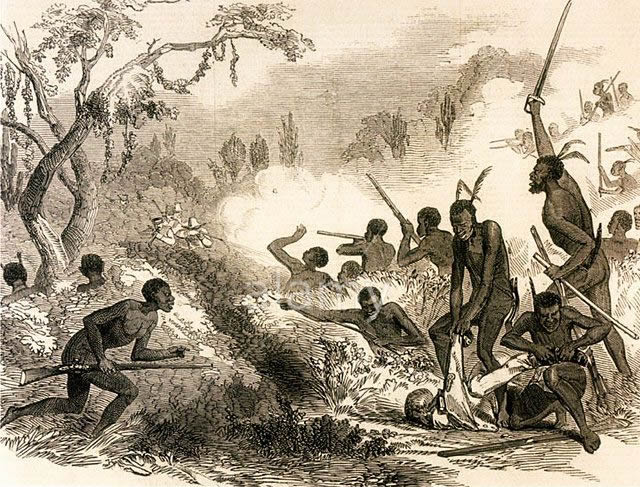
British Empire in Southern Africa - Zulu War At Bay the Battle of Isandula (Isandhlwana)
British Empire in Southern Africa

The first British involvements in South Africa were a result of maritime traffic going around the Cape of Good Hope to India. In the 17th century, the British East India Company had established trading stations at Madras, Bombay, and Calcutta.

By the 18th century, a thriving trade led the British East India Company to have its own navy to carry goods and personnel back and forth from England to India.

In 1652 the Dutch East India Company founded a trading station near what is now Cape Town and was busy attempting to extend its settlement into the interior, in the face of opposition from the indigenous African tribes.


The wars of the French Revolution began in 1792, and the Netherlands was conquered and occupied by the French. To the British, with their unparalleled Royal Navy and need for a way station to India, the Dutch colony at Cape Town was a tempting target. In 1806 the British captured Cape Town and kept it even after Napoleon I’s final defeat in 1815.

British Expansion

As the years progressed, the British became intent on making the colony more British; English replaced Dutch as the official language of the colony and its government. Anglican missionaries came to convert the Boers, the descendants of the Dutch settlers, to Anglicanism. (The Boers were staunch Calvinists of the Dutch Reformed Church.)

The missionaries also advocated the abolition of slavery. Indeed, due to the influence of the London Missionary Society, slavery was virtually abolished in South Africa even before it was in the empire as a whole in 1833.

Native Xhosa warrior

With wars against indigenous tribes an ongoing struggle for European settlements in the area, the British did not wish to take on any new imperial responsibilities in South Africa. The Kaffir Wars waged between the Europeans and the native Xhosa people were particularly lengthy and brutal.

Consequently, between 1852 and 1854 the British government recognized two Boer republics, the Orange Free State, named for the Orange River, and the Transvaal Republic, on the opposite side of the Vaal River. In 1853 the Convention of Bloemfontein formalized, at least for the time being, the British relationship with the Boers.

Indeed, the entire government of South Africa was reorganized when in 1853 an Order in Council for Queen Victoria established fully representative government in the Cape Colony, with a parliament set up in Cape Town.

In 1877 the imperialist prime minister Benjamin Disraeli expanded the Cape Colony with the annexation of the Boer Transvaal Republic. He sent out a new governor of Cape Colony to oversee the process in the colony: Sir Henry Edward Bartle Frere, who arrived in Cape Town in April 1877.

The ninth, and final, Kaffir War broke out in October 1877, and although it ended with the defeat of the Africans, Frere was still alarmed. In Frere’s view, the most immediate problem lay in the relations with the Zulu Kingdom, now under King Cetewayo.

Frere felt that the presence of the Zulu Kingdom, with its 50,000-man army, had to be dealt with by force. On January 11, 1879, British commander Chelmsford’s South African Field Force crossed the border into Zululand. Early on the morning of January 22, Chelmsford set off after the Zulu regiments.

He left a force to hold Isandhlwana, the main force of which was the 1st Battalion of the 24th Regiment. The Zulus, some 20,000 strong, pounced on the force left behind at Isandhlwana; not one British soldier was left alive. From there, the Zulu advanced to a garrison that was mostly from the 2nd Battalion. After 12 hours of fighting, the Zulu retreated.

On March 28, 1879, the British, fighting the Zulu at Hlobane, narrowly escaped another disaster like Isandhlwana. Almost immediately, plans were made to reenter Zululand; the image of a victorious Cetewayo was more than the London government could tolerate. On May 31 Chelmsford again advanced into Zululand, determined on a final conquest to redeem himself for his fatal miscalculation at Isandhlwana.

On July 4, Chelmsford attacked Cetewayo’s royal kraal at Ulundi and crushed the Zulu regiments. Cetewayo was captured on August 28, 1879, but Queen Victoria intervened to free him in 1883. On February 8, 1884, Cetewayo died amid rumors he had been poisoned.

Agitation for Freedom

Ironically, the removal of the Zulu threat did not mean peace for British South Africa. After the war, the Transvaal Boers began to agitate again for their freedom, taken from them by Shepstone’s annexation in 1877. On December 12, 1880, they united to fight for their independence.

The British forces were unprepared for the superior marksmanship, modern weapons, and guerrilla tactics employed by the men of the Boer commandos. Prime Minister William Gladstone, opposed to the imperialist philosophy of his rival Benjamin Disraeli, made peace with the Boers. By August 8, 1881, the Boers ruled again in the Transvaal capital of Pretoria. In 1871 diamonds were discovered in the Cape

Colony. One of those caught up in the diamond rush was Cecil Rhodes. In 1881 he founded the De Beers Diamond Company. Pressing north into native African country (and away from stronger Boer resistance), Rhodes was instrumental in the annexation of Bechuanaland, today’s Botswana, in 1885. His primacy among those in the Cape Colony was recognized in 1890 when he became prime minister of the Cape Colony.

Coveting the possible diamond hoard in the Transvaal, Rhodes sent Leander Starr Jameson, his assistant during prior wars, on a raid into the Transvaal Republic on December 29, 1895.

Jameson and his men were quickly arrested and handed over to the British for trial and sentencing. For Rhodes, the punishment was more embarrassing; in 1896 he was forced to resign as prime minister for the Cape Colony.

The Jameson Raid seemed to the Boers another British attempt to conquer them and end their independence once and for all. In 1897 Joseph Chamberlain, the colonial secretary, or secretary of state for the colonies, appointed the ardent imperialist Alfred Milner as high commissioner for South Africa.

His views on empire were very similar to Frere’s. Instead of the Zulus, Milner saw the Boers as the main threat to British rule in South Africa. The British prime minister, Robert Cecil, Lord Salisbury, was an ardent empire-builder. While sporadic negotiations continued, both sides prepared for war, and Chamberlain sent reinforcements from England.

Paul Kruger, a leader of the Boer resistance, determined to strike before the reinforcements could arrive. He issued an ultimatum, which would expire on October 11, 1899. This saved the British the trouble— and the blame—of declaring war themselves.

Kruger followed his ultimatum with a lightning advance by his commandos into both the Cape Colony and Natal Province. Kruger had 88,000 men and knew the British only had 20,000.

However, Kruger underestimated the immense forces the British Empire had available. According to some estimates, by the end of the war, the British Empire committed a staggering 450,000 men to fight the Boers.

The British forces in South Africa were commanded by General Sir Redvers Buller, who proved to be a disappointing commanding officer. Time and again, he and his troops were defeated.

On January 10, 1900, General Frederick Sleigh Roberts arrived in South Africa to replace the befuddled Buller. Roberts immediately went on the offensive against the Boers. Roberts led the British to victory on February 27 and 28, and March 13, and on May 27, 1900, he entered the Transvaal, determined to bring the war to a conclusion.

On June 2 Kruger retreated from the capital of Pretoria, which Roberts entered in triumph three days later. The defeat of the Boer armies was sealed when Buller arrived in the Transvaal from Natal on June 12.

Between August 21 and 27 the last major battle of the war took place when Roberts and Buller defeated Boer general Louis Botha at Bergendal. In December 1900, with formal hostilities over, Roberts returned to Britain to become commander in chief of the army.

Roberts’s second-in-command, Kitchener, was left to oversee what soon became a guerrilla conflict. He adopted a draconian policy to stop the commandos, ordering his men to burn down Boer homesteads, destroy their crops, and run off or kill their livestock.

Kitchener introduced concentration camps in which to hold the dispossessed Boer families of the commandos. The conditions of the camps were appalling, and disease was endemic. According to some estimates, 28,000 Boers died in 46 camps, and between 14,000 and 20,000 Africans died in the camps.

At the same time, the movement of the Boer commandos was hampered by a series of armored blockhouses. On January 28, 1901, Kitchener began a series of fierce offensives designed to wear down the commandos in a battle of attrition. On May 31, 1902, a peace settlement was made bringing the war to an end at Vereeniging.

The Boers had been defeated on the battlefield, but had retained their independent spirit. Just two months earlier, on March 26, 1902, Rhodes had died, to be buried in his beloved Rhodesia. As a new century opened, a new and unknown future began for the British in South Africa.

British Occupation of Egypt

The British militarily defeated Egyptian nationalist forces led by Ahmed Urabi at the Battle of Tel-el-Kebir in 1882
The British militarily defeated Egyptian nationalist at the Battle of Tel-el-Kebir in 1882

Through diplomatic negotiations in 1881–82, the British and French reached an agreement whereby the French occupied Tunisia in North Africa and Britain took Egypt.

The British militarily defeated Egyptian nationalist forces led by Ahmed Urabi at the Battle of Tel-el-Kebir in 1882. The Dufferin Commission was then sent to Egypt to make recommendations as to what should be done.

Initially, the British claimed that the occupation was a temporary one, but geopolitical considerations and ongoing conflict in the Sudan under the Mahdi led to the long-term occupation of Egypt by the British.


The British superimposed their own administration and became the de facto rulers of Egypt while maintaining the facade of Egypt as an autonomous province of the Ottoman Empire as arranged during the rule of Muhammad Ali.

The khedive was retained, with British advisers in the key government offices. A nonelective legislative council of Egyptians served in an advisory capacity. This two-tiered, often-cumbersome administration led to British control over all aspects of government from the judicial to financial to education.

Evelyn Baring, later Lord Cromer, was appointed consul general in 1883. Cromer was the virtual ruler of Egypt until 1907, when he was forced by the British government to retire following an increase of Egyptian nationalist discontent.

Evelyn Baring, 1st Lord of Cromer

A fiscal conservative, Cromer attempted to lessen the financial burdens on the fellaheen (peasants) but devoted few resources to education or other social programs.

The British did improve the irrigation systems in Egypt and also abolished forced labor. The railway system that benefited British commercial interests was also extended to the detriment of road and water transportation systems.

Mixed courts dealt with all cases involving foreigners, and civil courts with Egyptian judges and lawyers served the Egyptian population. A lively press that covered a wide range of political and social issues also developed, although the British carefully monitored it for subversive or anti-British opinions.

Over the years the number of British advisers proliferated. The presence of foreign troops and often arrogant British bureaucrats increased nationalist opposition to the occupation, particularly among the urban educated youth.

Mustafa Kamil who led the Watan (Nation) Party from 1895 until his death in 1908 was one of the most vociferous and fiery of the new generation of Egyptian nationalists.

Much to the dismay of the British, Tewfik’s successor, Khedive Abbas Hilmi supported the nationalist cause. Mounting Egyptian nationalism led to the emergence of political parties that the British vainly attempted to control. British control was not formalized until Egypt was declared a British protectorate with the outbreak of World War I in 1914.

Kingdom of Buganda

Kabaka Palace of Buganda kingdom

The early history of Buganda begins with the dynasties starting in roughly 1300. Among them, the Chwezi were the most prominent. The balance of power was changed by the arrival of Luo-speaking people from the Upper Nile who were looking for good land, which they found in Uganda.

Arriving in the 1500s, they represented a continuation of the migration of peoples from the Sahara region as desert encroached on the grazing area of their cattle. These pastoralists came as conquerors in many cases, imposing their ways on the more advanced people who became their unwilling subjects.

In 1497 the Portuguese explorer Vasco da Gama stopped in East Africa to take on Arab sailors familiar with the Arabian Sea. In 1498 he would visit India. Yet the riches of East Africa were not lost on the Portuguese, and they would return to attempt to carve out their own commercial empire in East Africa, with again the slave trade as one of their most lucrative markets.


In 1505 the Portuguese, with their firearms, would take both Kilwa and Mombasa as part of a virtual conquest of the entire Indian Ocean, presenting the Bugandan kings with a new and rich source of trade.

The tumultuous changes going on outside Buganda’s borders inevitably had an impact on the country and its people. Portuguese and Arabs clamored to have influence with the king, the kabaka, and contributed to instability within the royal house itself. The kabakas were still strong and took astute advantage of the turmoil between the Portuguese and the Arabs to expand their kingdom.

The 19th century saw even more powerful foreign powers enter the African scene. In 1806 Britain would conquer the Cape of Good Hope from the Dutch, beginning the modern history of South Africa. In 1830–31 the French would begin the conquest of Algeria, opening their history of empire in North Africa.

It was inevitable, as the European colonial powers expanded their control in Africa (Britain conquered Egypt in 1882), that the kingdom of Buganda could not stay immune from their influence.

Buganda was visited by explorers, such as Henry Morton Stanley and John Hanning Speke, who were impressed by what they saw of the native kingdom. By this time, the internal pressures were causing Buganda to begin to fail as a viable state.

Finally, in 1885 the kabaka Mwanga II took an irrevocable step that would inevitably cost Buganda its independence. Between 1885 and 1887 Mwanga II had some 45 Christian converts, some 22 Catholic and 23 Anglican, murdered.

Although he did this to thwart the growth of Christianity in his kingdom, the brave example of the martyrs only caused others to join their faith. At the same time, Muslims conspired to have a Muslim placed on the throne instead.

In 1867 a Bugandan king converted to Islam, if only in name. Mwanga II lost his throne, but managed to regain it. British intervention was guaranteed when, in the beginning of his persecution, Mwanga II had Anglican bishop James Hannington killed; Hannington had just been appointed to oversee the growing Anglican flock in East Africa.

At this time, Germany also entered the competition for Buganda. Carl Peters had established the colony of German East Africa, eventually known as Tanganyika. In November 1886 Great Britain and Germany signed an agreement dividing East Africa into the German zone and British East Africa, which bordered Buganda. Peters was determined to add all of Uganda to what the British called “German East.”

By May 1890 Peters got Mwanga II to agree to a German protectorate over Uganda. This sent shock waves through London, where the headquarters of the British East Africa Company could see their plans for an East African empire wither.

On May 13, the British prime minister Lord Salisbury succeeded in convincing Kaiser Wilhelm I to give up any claims to Uganda and nearby territories in return for the island of Heligoland, which he saw as vital to the defense of the Kiel Canal. However, the British were taking no chances the kaiser might change his mind.

The British government of Prime Minister Lord Roseberry dispatched Frederick Lugard in 1894 to end the chaos that was now causing Buganda to implode. Establishing a firm British protectorate over Buganda, as he later would do in Nigeria, in 1897, Lugard finally deposed Mwanga II.

Congo Free State

Flag of Congo Free State

In 1870 the Congo basin was unknown to Europeans. It contained 250 ethnic groups, 15 cultural regions mostly speaking Bantu languages, and a diverse climate and terrain, chiefly savanna and dense rain forest.

States were highly organized, with some large kingdoms; agriculture was varied; technology was somewhat developed, particularly metalworking; cloth and artworks were elegant, especially wood carvings, later partly inspiring cubism. Economies flourished despite unhealthy lowlands and depredations of East African slaves.

In 1877 Henry Morton Stanley completed tracing the 3,000-mile Congo River, emerging at its Atlantic mouth. British disinterest led Stanley to approach Leopold II of Belgium, whose machinations along with Stanley’s creations of stations on the Congo resulted, after the 1884– 85 Congress of Berlin, in the establishment of the Congo Free State with Leopold as the sole owner.


It had 22 miles of coastline, about 900,000 square miles of vaguely defined interior, and a blue flag with a gold star. Initially it exported palm products and ivory, until most of the elephants were killed.

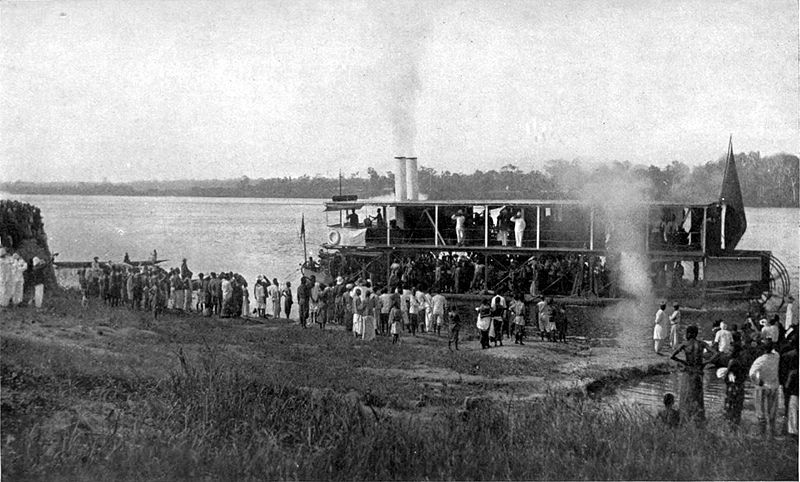
It was governed from Brussels; administrators were European volunteers. Indigenes were used for porterage, railroad and road building, harvesting wild rubber, and lumbering. From 1891 on, coercion forced workers to turn all ivory and rubber over to the state.

Congo Free State in 1899

Forced labor requirements were high. They were stabilized at 40 hours per month in 1903, which in practice often meant more than 20 days. Much land was awarded to commercial concessions; the remainder mostly became the property of the Congo state and then to Leopold. As a result, indigenous economies were destroyed.

In the late 1890s the Congo became profitable, as world demand for rubber grew. Greed, both Leopold’s (chiefly to embellish Belgium) and that of commercial concessions, along with demands for wild rubber, quota systems, and forced labor caused abuses and depopulation as well as dwindling amounts of rubber owing to lack of conservation and brutal slashing of vines.

Pressure for profit led to serfdom, lashings, physical mutilations (cutting off of ears or hands), and murder, especially by commercial concessions. Resistance was widespread and often effective; villages fled at the sight of a white man.


By 1900 criticism of the Congo’s maladministration mounted in both Britain and the United States. Leopold was indifferent to it. Many aspects of the situation in the Congo were not unique, but it and Leopold were easier targets than the Great Powers.

The campaign of E. D. Morel in Britain, the investigation and the 1904 report of British consul Roger Casement (which chiefly condemned the system, not individuals), Morel’s 1904 Congo Reform Association, missionaries, and Leopold’s own 1905 investigative commission confirmed the atrocities, despite some dubious evidence. Though Leopold resisted, Belgium wrested the Congo Free State from him and reluctantly annexed it in 1908 to end the abuses, which it largely did.

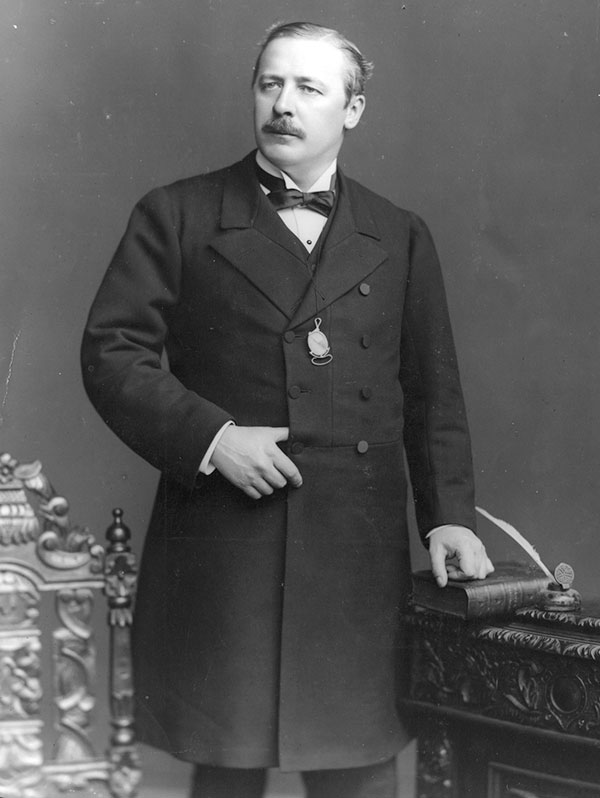
Leopold II of Belgium