Showing posts with label latin america. Show all posts

Abolition of Slavery in the Americas

Abolition of Slavery in the Americas

The history of chattel slavery in the Americas, from its beginnings in 1492 until its final demise in Brazil in 1888, has spawned a vast literature. So, too, has the process by which the institution of chattel slavery was formally and legally abolished.

A highly contentious, nonlinear, and uneven process that unfolded in different ways and followed distinct time lines in various parts of the Americas, abolition must be distinguished from manumission, in which slave owners granted freedom to individual slaves, which is not examined here.

Especially since the 1960s, historians have examined many different aspects of abolition in the Americas, including the intellectual and moral impulses impelling it; the history of diverse social movements devoted to compelling colonial, state, and national governments to implement it; and the role of various individuals and groups—including merchants, planters, bureaucrats, and colonial, national, and imperial governments, and slaves themselves—in retarding or accelerating the process.


The first formal abolition of slavery in the Western Hemisphere came not from a national government but from state legislatures in New England and the Mid-Atlantic states of the not-yet-independent United States of America.

In 1777 the Vermont state assembly became the first governmental entity in the Americas to abolish slavery within its jurisdiction. In 1780 the Pennsylvania state assembly passed a law requiring all blacks henceforth born in the state to become free upon reaching age 28.

State laws mandating the end of chattel slavery, each stipulating different time lines and provisions, were passed in Massachusetts and New Hampshire (1783), Rhode Island and Connecticut (1784), New York (1799), and New Jersey (1804).

Significantly, actual abolition sometimes lagged for decades following passage of such laws—as in New Jersey, where legal slavery persisted until ratification of the Thirteenth Amendment to the Constitution in 1865.

Because slavery did not comprise an important component of any of these states’ economies, organized opposition to abolition was limited, and abolition itself carried few economic costs to slaveholders.

As individual states were passing laws for gradual emancipation, the Northwest Ordinance of 1787 banned slavery in the Northwest Territories, setting the stage for the sectional conflict between North and South that ultimately led to the American Civil War.

Far more consequential for the eventual abolition of slavery in the Western Hemisphere was the Act for the Abolition of the Slave Trade passed by the British parliament in 1807, and put into effect in 1808, outlawing the transatlantic slave trade.

The law also authorized the British navy to suppress the slave trade among all slave traffickers, making Britain, in effect, the policeman of the high seas. The U.S. government passed less sweeping legislation in 1808 banning further import of slaves. Three years later, the British parliament made participation in the slave trade a felony.

Scholarly debates have swirled regarding the origins of and inspiration behind these laws. Some historians have emphasized the rise of a religion and Enlightenment inspired antislavery and humanitarian impulse among Quakers, evangelical Methodists, Unitarians, and others in providing the impetus behind the British abolition of the slave trade.

An expansive literature pays special attention to leading abolitionists like William Wilberforce and to the many antislavery societies, writers, and publications that blossomed in the late 1700s and early 1800s. Other scholars have stressed the growing commitment to the ideology of free wage labor on the part of Britain’s leading capitalists.

This interpretive school has located Britain’s intensifying opposition to slavery within the broader context of a rapidly developing global capitalist economy and a powerful domestic labor movement that used the symbol of slavery to portray the workers’ plight and denounce capitalism.

Ironically, while the 1807 law made Britain the first nation to outlaw the transatlantic slave trade, from the mid-1600s leading British economic interests had also been one of the main motors behind, and beneficiaries of, the slave trade.

While the 1807 law presaged the eventual demise of African slavery in the Americas, it did not abolish slavery, or call for the abolition of slavery, or free a single slave. Nor did the law prohibit individual nations or colonies from slave trafficking within their borders.

In nations and colonies with large slave populations—including Brazil, the United States, and throughout the Caribbean Basin—chattel slavery could, in theory, continue indefinitely by “natural population increases” among slaves (population increases resulting from births over deaths and excluding external influxes).

The outlawing of the Atlantic trade prompted slaveholders across the Americas to implement policies intended to increase slave populations, such as forced impregnation and rape of slave women.

Local slave markets reflected these changes, as prices of female slaves of childbearing years rose substantially in many areas. The 1807 law provoked fierce resistance in British colonies such as Jamaica, Antigua, and Trinidad, whose colonial assemblies at first rejected, then grudgingly accepted, the imperial mandate.

Similar patterns unfolded elsewhere, as imperial laws intended to place limits on slavery and the slave trade met stiff resistance by slave owners in the colonies.

Overall, such laws originated in national governments’ responses to mounting domestic and international opposition to chattel slavery and the actions of slaves themselves and their many forms of resistance to the fact and terms of their enslavement. A survey of the British, French, and Spanish colonial empires highlights these broad patterns.

Great Britain

In Britain the 1807 and 1811 laws were followed by the amelioration laws of 1823, meant to improve the living conditions of slaves. Far more consequential was the Abolition of Slavery Act of 1833, which went into effect on August 1, 1834.

The 1833 law abolished slavery throughout the empire, while stipulating a period of apprenticeship in which slaves over the age of six would continue working for four years for their former masters.

A major slave rebellion in Jamaica in December 1831 (the “Christmas revolt”) played a major role in prompting Parliament to pass the 1833 law—an illustration of the role played by slaves in advancing their own emancipation.

Christmas revolt in Jamaica

In 1838, over the vociferous objections of slaveholders, Parliament proclaimed complete emancipation. Upper and Lower Canada followed the same trajectory as British colonies elsewhere in the Americas, with final emancipation coming in 1838.

For the next 27 years Canada would serve as a refuge for escaped slaves from the United States, especially after the U.S. Fugitive Slave Law of 1850 made no state in the Union immune from slave-catchers and bounty hunters.

In France, with the convening of the Estates General in 1789, the Société des Amis des Noirs (Society of the Friends of the Blacks) called for the abolition of the slave trade and emancipation of slaves within the colonies.


The call was rejected after a powerful coalition of white colonists successfully prevented debate on the topic. With the eruption of the Haitian Revolution from 1791, the French assembly relinquished its jurisdiction over the question.

Three years later, in 1794, the Convention outlawed slavery throughout the empire and granted rights of citizenship to all adult males. In 1801, Haitian rebel leader Toussaint Louverture, whose forces had just gained control of all of Hispaniola, promulgated a constitution that prohibited slavery in perpetuity throughout the island.

The following year, in 1802, Toussaint was captured and transported to France, and Napoleon I reinstituted slavery throughout the French colonies. After France’s defeat in the Napoleonic Wars, in 1817 the French constitutional monarchy passed a law abolishing the slave trade by 1826.

A few months after the overthrow of the monarchy and establishment of the Second Republic, and under the leadership of prominent abolitionist Victor Schoelcher, on April 27, 1848, France abolished slavery throughout the empire.

Spain

In Spain the first effort to abolish slavery came soon after the overthrow of King Ferdinand VII and during the tumult of the Napoleonic occupation, when in 1811 the Cortes (parliament) abolished slavery throughout the empire.

The law was largely ignored. In 1820, following a major revolt against a restored constitutional monarchy, the Cortes abolished the slave trade while leaving slavery itself intact—though after the independence of Latin America in the early 1820s, Spain’s American empire had been reduced to one major colony: Cuba.

Abolitionist sentiment within Cuba mounted through the first half of the century, despite the colonial government’s success in crushing organized antislavery agitation. In 1865, in the wake of the U.S. Civil War, the Spanish Abolitionist Society was founded, its considerable influence rooted in mounting opposition to the constitutional monarchy.

In 1868 a liberal revolution triumphed in Spain, its leaders advancing as one of their principal aims the abolition of slavery in Cuba. In July 1870 the Cortes passed the Moret Law, which emancipated children born to slaves after 1868 and slaves age 60 and older.

Envisioned as a form of gradual abolition, the law’s provisions were undermined by both planters and slaves. Planters sought to delay the law’s implementation and subvert its provisions, while slaves pushed its boundaries in the effort to secure their freedom.

The Ten Years’ War on the eastern half of the island complicated the situation even further. Finally, on October 7, 1886, the Spanish government eliminated various legal categories of quasi slavery and abolished slavery throughout the island.

A brief summary of other European nations’ abolition laws once again highlights the partial and uneven nature of the process of emancipation. Sweden abolished the slave trade in 1813 and slavery in its colonies in 1843. In 1814 the Netherlands outlawed the slave trade and, nearly half a century later in 1863, abolished slavery in its Caribbean colonies.

In 1819 Portugal outlawed the slave trade north of the equator and in 1858 abolished slavery in its colonies while providing for a 20-year period of apprenticeship similar to the British model. Denmark abolished slavery in its colonies in 1848, the same year as France.

Turning to the independent nation-states of the Americas, most of the newly independent nation-states of Latin America abolished slavery in the first three decades after independence.

In 1821 Gran Colombia (comprising most of present-day Colombia, Venezuela, and Ecuador, and parts of Bolivia and Peru) became the first Latin American nation to adopt a law calling for gradual emancipation, though final abolition did not come for more than three decades (Ecuador in 1851, Colombia in 1852, Venezuela in 1854), final abolitions followed by prolonged periods of apprenticeship that closely resembled slavery.

Chile abolished slavery in 1823; Mexico in 1829; Uruguay in 1842; Argentina in 1843; and Peru in 1854. In 1850 Brazil outlawed the transatlantic slave trade, prompting a brisk internal trade in slaves that lasted until the final abolition of slavery in 1888.

United States

In the United States, in the aftermath of state laws abolishing or limiting slavery from the 1770s to the early 1800s, abolitionist and antislavery agitation mounted. The U.S. Constitution took an ambiguous stance toward slavery, neither prohibiting it nor precluding the possibility of its abolition and making unconstitutional any law passed before 1808 banning the importation of slaves.

After the Louisiana Purchase in 1803, controversies over the expansion of slavery into the territories sharpened the sectional conflict between North and South that dominated U.S. politics through much of the 19th century, culminating in the Civil War.

Such controversies brought the nation to the brink of civil war in 1820 (forestalled by the Missouri Compromise) and again in 1850 (forestalled by the Compromise of 1850). In the 1830s the rise to prominence of vocal abolitionists like William Lloyd Garrison and Wendell Phillips sharpened the sectional conflict even further.

In 1861, following the election of Abraham Lincoln as president, southern slaveholding states formed the Confederate States of America and announced their secession from the Union, inaugurating the Civil War.

Less than two years later Lincoln issued the Emancipation Proclamation, which, despite its title and symbolic significance, freed no slaves. The final abolition of slavery came in December 1865 with the ratification of the Thirteenth Amendment to the Constitution.

Brazil

Brazil, the last nation in the Western Hemisphere to abolish slavery, offers an instructive contrast to the U.S. experience. Earlier generations of historians emphasized two key differences: Brazil did not have a comparable sectional conflict and Brazil abolished slavery without recourse to civil war.

More recent scholarship has blurred these distinctions, with greater attention to Brazil’s major regional differences and to the role played by the specter of violence and civil strife in accelerating the process of emancipation.

The British prohibition of the transatlantic slave trade from 1808 did not diminish the number of slaves imported into Brazil, as the government and slave traders ignored the law. An 1831 treaty between Brazil and Great Britain banning the importation of slaves also had little practical effect, as the Brazilian government did little to enforce its provisions.

Over the next 20 years, an estimated half a million slaves poured into the country. In 1850, in response to tremendous British pressure, Brazil passed a law putting teeth into the prohibition, after which the transatlantic slave trade diminished markedly. The 1850 law prompted two major shifts.

Planters began creating conditions under which natural population increases would permit perpetuation of slavery, including improved nutrition and living conditions, enhanced surveillance and control, and forced reproduction. Slave trafficking within the country also increased dramatically, with major flows from the Northeast to the booming coffee-based states of the South.

By the 1860s, however, the Atlantic world’s mounting moral opprobrium toward slavery, combined with the carnage of the U.S. Civil War, made clear to many Brazilians that abolition was inevitable and that a gradualist approach to the problem was preferable to civil war. What eventually emerged from these debates was the Rio Branco Law of September 28, 1871.

Dubbed the Law of Free Womb, the law called for all children born of slaves to be free, following a period of semibondage until they reached age 21. Many, however, including prominent abolitionists in the Chamber of Deputies such as Joaquim Nabuco, Jeronymo Sodré, and Rui Barbosa, saw the law as fatally flawed, permitting slavery’s survival well into the 20th century.

In the late 1870s abolitionist pressures intensified, as did urban violence, plantation uprisings, and civil strife. Slaves especially pushed the boundaries of the law, insisting on their own emancipation.

Finally, on May 13, 1888, the Brazilian parliament passed a law consisting of the following two provisions: “Article 1. From the date of this law slavery is declared abolished in Brazil. Article 2. All contrary provisions are revoked.” After 396 years, legal slavery in the Americas had ended.

The process by which chattel slavery was abolished in the Americas followed a number of distinct trajectories, as various groups of actors in conflict and alliance propelled and forestalled the outcomes.

Nowhere was abolition inevitable; everywhere its achievement resulted from the determined actions of many different individuals and groups. In all cases, the actions of slaves were integral to the process, a fact to which a large and growing body of scholarship amply attests.

Andean Revolts

In what has been called the age of Andean insurrection, there erupted in the Andean highlands of Peru and Bolivia from 1742 to 1782 a spate of revolts, uprisings, and rebellions that rocked the Spanish Empire, threatening their rule across much of the Andes and prompting a host of reforms intended to quell the disturbances and reassert the Crown’s hegemony.

Unlike the situation in the viceroyalty of New Spain, where revolts and uprisings were common but generally small-scale and localized, several of the Andean rebellions assumed the character of major regional conflicts, most notably the Great Rebellion led by the second Tupac Amaru from 1780 to 1782 (the first Tupac Amaru had been captured and executed two centuries earlier, in 1572).

Taken together, these Andean rebellions reveal the deep fissures of race and class that marked 18th-century colonial Peruvian society; the enduring persistence of preconquest indigenous forms of religiosity, culture, social organization, and political and communal practices; and the intensification of the structural violence and systemic injustices of Spanish colonialism under Bourbon rule.

The first major rebellion in 18th-century Peru was led by the Jesuit-educated mestizo Juan Santos Atahualpa, who claimed direct descent from the Inca emperor Atahualpa, captured and executed by the Spaniards in 1533. For more than 10 years, from 1742 to 1752, Juan Santos Atahualpa led a small army of Indians and mestizos in a protracted guerrilla war against the Spanish authorities.


Based in the eastern montaña, between the Central Highlands to the west and the vast Amazonian jungles to the east, the army of Juan Santos Atahualpa was never defeated in open battle and the leader himself never captured; in 1752 he and his troops launched an audacious foray into the heart of Spanish-dominated territory before retreating back into the eastern jungles. The movement itself, like others of this period, was inspired by a messianic ideology that foretold the end of Spanish domination and the return of Inca rule.

A major point of contention among scholars has been the extent to which this movement represented a genuinely highland Indian revolt or whether it is better understood as a frontier movement with only tenuous links to the core highland zones of Spanish domination and control.

The preponderance of evidence indicates the movement’s frontier character while also underscoring substantial, if diffuse, highland Indian sympathy in the heartland of the Spanish domain.

It is true that highland Indians did not rise up en masse in support of the movement. Yet substantial evidence also shows the movement’s ranks populated by significant numbers of highland Indians and that Spanish authorities perceived the movement as a grave threat to their rule.

A series of other, more localized revolts and uprisings marked the decades between the 1750s and the early 1780s. By one count, the 1750s saw 13 such revolts; the 1760s, 16; and the 1770s, 31. The year 1780 saw 22, and 1781, 14, including the launching of the Great Rebellion by Tupac Amaru II in November 1781.

The causes of this upsurge in insurrectionary activity have been attributed to a host of interrelated causes, all having to do with the structural oppression and exploitation of Spanish colonial rule—more specifically, the practice of forced mita labor in the Andes; onerous and rising tax rates; the forced sale of goods under the institution of repartimiento; and the quickening pace of reform under the Bourbons, whose economic policies from the mid-1700s intensified the demands for Indian labor.

The Great Rebellion, which rocked the entire southern highlands in 1781–82, represented the most serious threat to Spanish domination in the Americas during the colonial period. The subject of an expansive scholarly literature, the insurrection launched by Tupac Amaru II sought to expel the reviled Spaniards and in their stead install a divinely inspired neo-Inca state.

The depths of the millenarian impulse propelling the movement and the breadth of the popular support the movement garnered constitute powerful evidence for the profundity of the cultural crisis among indigenous and mestizo Andean highland peoples in the late colonial period.

The Great Rebellion began on November 4, 1780, with a raid on the Indian town of Tinta in southern Cuzco Province, where rebels captured and executed a local official infamous for his abuses of the repartimiento system. Moving south, the rebels quickly gained control of much of the southern highlands, from Lake Titicaca to Potosí and beyond, suggesting a high degree of advanced preparation and planning.

In January 1781 the rebels laid siege to the ancient Inca capital of Cuzco. The siege faltered with the speedy arrival of Spanish reinforcements, and soon after Tupac Amaru II and numerous lieutenants were captured and, in May 1781, executed.

The executions failed to staunch highland rebel activity, however, as remnants of Tupac Amaru’s army joined forces with a similar movement led by one Tupac Katari, laying siege to La Paz (Bolivia) from March to October 1781.

Tupac Katari also was captured, and in January 1782 the Spaniards negotiated a peace agreement with surviving rebel leaders. Sporadic outbreaks continued through the early 1780s across the southern and central highlands.

It is estimated that altogether some 100,000 people died in the Great Rebellion of 1780–82. In response to these crises, the colonial authorities exacted swift retribution while also attempting to address some of the root causes of the violence, reforming the judicial system and selectively easing tax burdens. Yet social memories in the Andes are long, and the deep social divisions exposed by these massive upsurges of violence endured.

In subsequent decades, the Creole, mestizo, and Indian elites of Peru, Bolivia, and adjacent highland Andean regions emerged as among the most conservative in all of Latin America, the specter of violence from below representing an ever-present danger to their privileges and interests. The deep social and cultural divisions exposed in the age of Andean insurrections remain, for some observers, readily apparent to the present day.

Asian Migration to Latin America

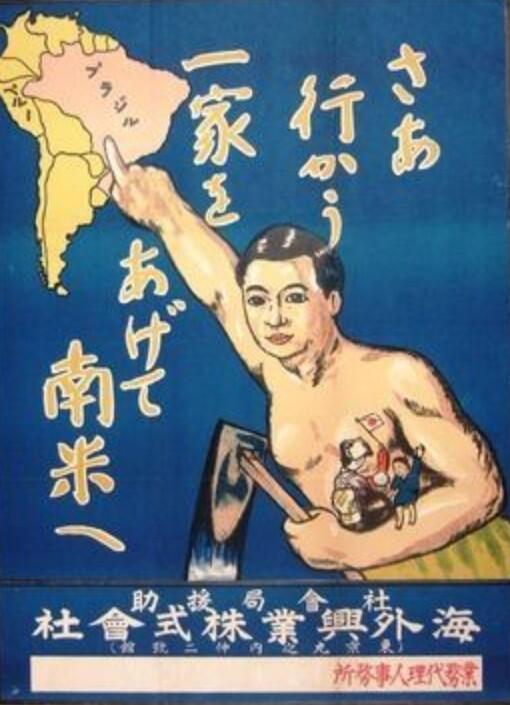
A poster used in Japan to attract immigrants to Brazil

There has been a long history of Asian migration to Latin America, with Chinese, Japanese, and Korean populations now in most countries in Central and South America. In addition there are also significant Indian communities in some countries, especially Guyana, and small numbers of Vietnamese.

The first links between the two areas may have been during the Ming dynasty in China, when some of the fleet of Chinese Admiral Cheng Ho may have reached the Americas. On many of his voyages members of the crew did not return with the fleet, and if any of his ships did reach the Americas, it seems likely that they would represent the first recent Asians to settle in the Americas.

It is also worth mentioning that in 1492, when Christopher Columbus sailed the Atlantic, he expected to reach Asia, and in 1519 Ferdinand Magellan started his voyage that was, after Magellan’s death, to circumnavigate the world, sailing through what became the Straits of Magellan across the Pacific Ocean, proving that it was possible to make the voyage.


However, there was little migration from Asia to the Americas until the early 19th century. Few Chinese ventured overseas during this period, except for those already in Southeast Asia—the Nanyang, as they called it.

In 1637 the Japanese government banned travel overseas and requested their citizens to return home; Korea was so isolated that travel was extremely difficult until recently. It is probable, however, that some Filipinos did settle in Latin America, especially in Peru, the center of Spanish power, as there were close shipping ties between Lima and Manila.

In the early 19th century the increased frequency of traveling overseas by ship and overpopulation in China saw many Chinese begin to migrate, initially to the favored destinations in Southeast Asia and around the Indian Ocean, and then to the Americas.

The California gold rush certainly saw many Chinese move to California and others moved in search of employment to Mexico and then to the Caribbean and South America. As a result, Chinese merchants started establishing businesses in cities and large towns along the Pacific coast. Some were farmers growing vegetables, others running shops, laundries, or restaurants.

A few Chinese families settled on the eastern coast of Latin America. A sizeable community was established in British Guiana (now Guyana), many working on plantations. The Chinese in British Guiana form the subject of novelist Robert Standish’s Mr. On Loong.

In addition, mention should be made of the family of Philip Hoalim from Guyana—Hoalim later became involved in politics in Singapore, forming the Malayan Democratic Union, the first political party ever established in Singapore.

As well as the Chinese in British Guiana, there was also a much larger Indian community. Known as the East Indians, to differentiate them from the West Indians, many spoke Hindi or Urdu, and there are numbers of Hindu temples and Muslim mosques in the capital of Georgetown. In neighboring Suriname, a former Dutch colony, there are also many East Indians and Chinese.

There is even a statue of Mohandas Gandhi in Paramaribo, Suriname’s capital. With its Dutch connections, there are also Indonesians (mainly from Java), many descending from indentured servants who came before the 1940s. Smaller Indian communities in Brazil, Paraguay, and northern Argentina have been instrumental in the introduction and breeding of zebu and Brahman cattle.

Chinese Communities

During the latter half of the 19th century, economic opportunities encouraged many Chinese to migrate to Cuba and Peru, where they worked on sugar plantations, in mining, and on haciendas, as well as running shops in townships. However, Cuba started to restrict the number of Chinese migrants. At the same time, the

Mexican government started encouraging migration from China. Porfirio Díaz, president 1876–80 and again 1884–1911, wanted Chinese coolies as a cheap labor force for building infrastructure in northern Mexico, where many settled.

As with the Chinese in Peru, there were gradual changes in the economic status of the migrant communities. Whereas in the 1870s most were manual laborers, by the 1900s many were running businesses.

By 1912 there were 35,000 Chinese in Mexico. Some used it as a route to the United States, but many others established businesses, often in poor suburbs. As a result, during periods of instability, especially during the Mexican Revolution, when rioting started, Asians were often the victims of mobs. The Mexican revolutionary hero Pancho Villa was definitely anti-Chinese, calling U.S. citizens Chino blanco (“white Chinese”).

When he took the town of Torreón on May 25, 1911, his forces and several thousand locals massacred 303 Chinese and five Japanese. When he was eventually defeated by Emilio Obregón, he is reported to have said “I would rather have been beaten by a Chinese than by Obregón.”

In February 1914 anti-Chinese riots took place in Cananea, and local Chinese took refuge in a U.S.-owned building, and in March 1915 many Chinese were attacked and robbed in rioting in Nogales. In spite of these attacks, many Chinese continued to migrate to Mexico, with 6,000 arriving in 1919–20. The Chinese community remains important in Mexico.

In Central America, there were small Chinese communities in each country, and most were involved in running small businesses. By the 1930s they had begun to dominate trade in many towns in El Salvador, so much so that the 1939 constitution included protections for indigenous small traders.

A new law, passed in March 1969, limited the running of small businesses in the country to people born in Central America, specifically excluding naturalized citizens.

However, many Chinese continued to operate with their businesses owned by middlemen. In Honduras, many small businesses were also owned by Chinese until the 1969 war with El Salvador, which led to fervent nationalism breaking out in the country and moves to reduce the number of Chinese-owned shops.

In Central America today there are small numbers of Vietnamese, and there is also a sizable Vietnamese population in Cuba, largely as a result of political ties between the two communist countries.

As well as in Peru, there are also significant Chinese communities in Brazil, Argentina, and Chile. Indeed bilateral ties and trade (with China) with all three countries have increased in recent years, offering many Chinese in Latin America new opportunities for establishing businesses.

Chinese-language gravestones can be seen in cemeteries throughout Latin America, although most seem to be located in foreign cemeteries, such as the British Cemetery at Chacarita in Buenos Aires or its counterparts in Chile.

Most Latin American countries now recognize the People’s Republic of China, but a few still extend diplomatic recognition to the Republic of China (Taiwan) as the legitimate government of the whole of China. For these, most ties are with Taiwan.

In Paraguay, the Taiwanese government and community plays an important role in commercial life in Asunción and has been involved in major projects, such as the refurbishment of the Paraguayan foreign ministry.

Japanese and Korean Settlers

In Brazil, the largest country in Latin America, there are many people of Chinese and East Indian ancestry and also some migrants from Malaysia involved in rubber cultivation. In the southern part of the country there are also increasing numbers of Japanese—there are said to be over 600,000 Brazilians with Japanese ancestry.

A number of the Japanese can trace their origins in Brazil back to 1908 when an agreement with the municipal authorities in São Paulo allowed Japanese to settle in the hinterland. They established many vegetable farms, and there are Japanese grocery stores, bookshops, and even geisha in São Paulo today.

There were also numbers of Japanese farmers who left Japan during this period, with many settling in Peru, Brazil, and Paraguay, where the government was encouraging foreigners to move to the country and establish colonies.

Many were poor Japanese in search of work, but quite a number were well educated. Some of the latter settled in Panama—a few involving themselves in businesses so closely linked to the Panama Canal that spying by them has long been alleged.

One of them, Yoshitaro Amano, a Japanese store owner who had lived in Panama City, spied on U.S. ships using the Panama Canal. He later fled Panama and was arrested for spying in Nicaragua, Costa Rica, and then Colombia.

Perhaps the most prominent example of the role of the Japanese in Latin America concerns two of the Japanese who left Kumamoto, Japan, moving to Peru in 1934: Naoichi Fujimori and his wife, Mutsue. Four years later their son, Alberto, was born, and the parents applied to the local Japanese consulate to ensure the child retained Japanese citizenship.

He worked as an agricultural engineer and became dean and then rector of his old university, also hosting a television show. In 1990 Fujimori, heading the Cambio 90 party (“Change 1990”), defeated the author Mario Vargas Llosa in the election for president in a surprise result.

Although he was Japanese, Fujimori gained the political nickname “el chino” (“the Chinese man”), with many observers crediting his victory with his ethnicity, which set him apart from the political elite of Spanish descent.

Fujimori had campaigned on a platform of “Work, technology, honesty” but in what became known as Fujishock, he instituted massive economic reforms and invested the office of the president with many new powers.

His wife, Susana Higuchi, also of Japanese descent, in a very public divorce, accused him of stealing from donations by Japanese foundations. Reelected in 1995, Fujimori won the 2000 election, but soon afterwards a massive corruption scandal emerged. Fujimori, overseas at the time, then went to Japan, where he resigned.

In November 2005 he flew from Japan to Chile and was arrested on his arrival. On September 22, 2007, he was extradited to Peru where he was jailed awaiting trial. On December 12, 2007, Fujimori was convicted of abuse of authority and sentenced to six years in prison.

He faces three other trials on charges including murder, kidnapping, and corruption. Fujimori remains the bestknown politician of Asian ancestry to hold high office in Latin America, but he has also become a by word for corruption and political sleaze.

Of the Koreans who have settled in Latin America, many run shops and small businesses. There are parts of Buenos Aires and also Rio de Janeiro with large Korean populations. In Uruguay there has been an influx of Koreans, many associated with Rev. Sun Myung Moon.

Despite the high-profile involvement of Fujimori in Peruvian politics, most of the Asians in Latin America shun media hype. Although many operate small businesses either importing Chinese merchandise or household consumer products into Latin America or run restaurants, a new generation of highly educated Asians fluent in Spanish is emerging, many of whom were born in Latin America.

They are starting to enter the professions of law, accountancy, and banking, many having totally assimilated into the communities in which they live. When Hu Jintao, the general secretary of the Chinese Communist Party, visited Brazil, his first overseas visit after assuming the leadership of the People’s Republic of China, he was greeted by thousands of Brazilians of Chinese ancestry.

Baroque Culture in Latin America

Baroque Culture in Latin America

The term baroque—originally a pejorative label meaning “absurd” or “grotesque”—is used to designate the artistic style that flourished in Europe and abroad in the 17th and early 18th centuries.

The baroque influence reached Latin America in the mid-17th century and continued to make its presence felt long after 1750, the year conventionally given as the end of the baroque movement in Europe. The artistic movement, which originated in Rome in tandem with the Catholic Counter-Reformation, emphasized vigorous movement and emotional intensity.

Baroque works were typically characterized by a highly ornamental style and extensive use of decorative detail. Given the movement’s roots in the Counter-Reformation, it comes as little surprise that most (though certainly not all) baroque art served a religious purpose.


Life-sized images aimed to capture the emotional states of their subjects (typically biblical figures), so that viewers could connect with the subject on an emotional level. On major holy days, religious statues, often dressed in ornamental garments, were paraded through the streets of Latin American cities.

While Latin American culture was clearly influenced by European styles and aesthetic ideals, Latin American baroque was by no means a mere duplicate of European artistic forms. Baroque music was generally more lively and less technically complex in a Latin American context than it was in Europe.

European innovations in the visual arts were selectively appropriated and transformed to suit a very different context. The result was a hybridization of European, Indian, and African cultural influences. Many baroque churches in Latin America, for example, include detailed carvings and other ornamentation that incorporate elements of indigenous spiritual beliefs and practices.

Similarly, paintings and sculptures from the baroque era often portray their subjects clad in the native garments or situated in surroundings suggestive of the local climate and geography. The biblical scenes found in the interior of the San Francisco Church in Santa Fé de Bogotá, Colombia, for example, depict biblical figures in a rich tropical environment.

Some of the finest examples of Latin American baroque art and architecture can be seen in the work of Antônio Francisco Lisboa, known more popularly as O Aleijadinho (the “Little Cripple”).

This Brazilian sculptor and architect’s masterpieces include baroque churches in São João del Rei and Ouro Preto, as well as the statuary (most famously the Twelve Prophets carved out of soapstone) at the Sanctuary of Bom Jesus do Matozinho in Congonhas do Campo.

Aleijadinho’s work, some of which he produced in the early years of the 19th century, serves as a reminder of the inapplicability of rigid periodization of artistic styles in the Latin American context.

The decades following independence witnessed a backlash against baroque culture among educated elites in Latin America. The movement for political independence had been inspired in large part by European Enlightenment ideals, and it was to European—and particularly to French neoclassicist—ideals that the Creole elites turned for a cultural model on which to base their newly independent societies.

On a more popular level, however, devotional art and pageantry and other expressions of popular culture continued to demonstrate a taste for theatricality and ornamentation characteristic of baroque culture well into the 19th century and beyond. In fact, the enduring presence of baroque aesthetic norms can still be observed in Latin American cultural expression.

Simón­ Bolívar

Simón­ Bolívar
Simón­ Bolívar

Revered throughout Spanish-speaking Latin America as the “Liberator,” whose single-minded determination forced Spain to grant independence to South America’s nascent nation-states in the 1820s, Simón Bolívar occupies a singular position as perhaps Latin America’s greatest patriot and hero.

Statues and busts of Bolívar grace public plazas across the continent, while his contemporary relevance remains readily apparent, as in Venezuela’s Bolivarian revolution, brainchild of President Hugo Chávez, elected in 1998. This popular reverence contrasts sharply with the contemporaneous opinion of Bolívar in the years before his death, when many Latin American elites reviled him as an autocrat and dictator.

His political trajectory is the subject of an expansive literature, as his political philosophy evolved from a broad republicanism and democratic idealism in the early 1800s to an antidemocratic autocracy and repudiation of republican ideals by the late 1820s.


Weeks before his death from tuberculosis, Bolívar himself expressed his disillusionment and lamented his failure to achieve his vision of a politically unified nation-state embracing all of South America, when he famously proclaimed: “America is ungovernable ... he who serves a revolution ploughs the sea.” His lament proved prescient, foreshadowing the endemic civil wars that wracked much of the first century of Latin American independence.

Born on July 24, 1783, in Caracas, capital of the Provinces of Venezuela of the Viceroyalty of Gran Colombia, Simón Bolívar was the son of Juan Vicente Bolívar and María de la Concepción Palacios y Blanco, one of the most distinguished Creole (American-born Spanish) families in the city of 20,000 inhabitants.

His education was eclectic and unconventional, influenced by emergent Enlightenment ideals of republicanism, popular sovereignty, and democracy, and by romantic notions regarding nature and the arts. As a youth, he traveled widely in Europe and North America, continuing his studies in Madrid, southern France, and elsewhere.

He married in May 1802 in Madrid and eight months later his wife died, a catastrophic personal event that he later claimed changed the trajectory of his life. “If I had not been left a widower... I should not be General Bolívar, nor the Liberator,” he later observed.

Returning to Europe, in December 1804 he attended the coronation of Napoleon I in Paris, an event that left an enduring impression. He was particularly struck by the popular adoration for the French emperor, which he envisioned for himself for liberating South America from Spanish rule.

In August 1805 on the Monte Sacro on the outskirts of Rome, he solemnly vowed that he would “not rest in body or soul till I have broken the chains that bind us to the will of Spain.” He would spend the next two decades struggling to fulfill that vow.

Bolívar’s military campaigns against the Spanish armies, culminating in Latin American independence, comprise the subject of a vast literature. The evolution of his political philosophy can be seen in three key documents.

The first, the Jamaica Letter of September 6, 1815, offered a critical appraisal of the status of the Latin American revolutionary movements and a series of predictions regarding Latin America’s future.

The political views inspiring Bolívar’s Jamaica Letter can be characterized as broadly nationalist and republican. The second document, a major speech before the Congress of Angostura in 1819, evinced far greater emphasis on the need for political unity and a strong central executive.

The third document, the Bolivian Constitution of 1825, represents the acme of Bolívar’s political shift toward a belief in a unitary executive and strong central state and his fears of civil war and political anarchy.

Many of his prognostications on Latin America’s future proved accurate, most notably the monumental difficulties of governing territories with no tradition of democracy and shot through with deep divisions of race and class.

Indeed, throughout his career as the Liberator, Bolívar sought to achieve a political revolution, independence from Spain, without sparking a social revolution from below. Remarkably, he largely succeeded.

The process by which popular memories of Bolívar transformed so dramatically after his death, from a despised autocrat to a popular hero and Liberator, represents yet another puzzle in the history of this revered Latin American patriot.

Independence to Republic in Brazil

Independence to Republic in Brazil

Unlike many Spanish-American countries that fought for independence and founded republics thereafter, the Portuguese colony of Brazil gained its independence virtually without bloodshed and remained under the same royal family that had once ruled the territory from afar. Hence Brazilian independence entailed a large degree of continuity.

The abolition of the monarchy later in the 19th century represented Brazil’s break with its European past, though the economic and cultural evolutions of the first few decades of independence prepared the way for political change by profoundly altering Brazilian attitudes and society.

Napoleon I’s armies disrupted both Iberian monarchies; the Portuguese prince, unlike his Spanish counterpart, decided to take advantage of his country’s overseas holdings and moved the royal family to Brazil in 1807.


At Rio de Janeiro, the new capital of the Portuguese empire from 1808, João became king in his own right in 1814, following the death of the mentally unstable queen for whom he had served as regent. When he became king, João proclaimed Brazil a kingdom, equal in status to Portugal.
This new standing permitted freer trade and led to the creation of various institutions in Rio de Janeiro, including a naval academy, a medical school, and Brazil’s first newspaper. Further, the new king established a full royal court in Rio, complete with 15,000 courtiers, bureaucrats, and aristocratic families who had also accepted exile from Portugal.

The Portuguese elites came to Brazil with strong senses of entitlement and an appreciation for French culture, neither of which had been damaged by the Napoleonic conquest of their country. Brazil enjoyed a comparatively smooth transformation from exploited colony to sovereign country with its own monarch in residence.

Not all Brazilians appreciated the Portuguese monarchy’s presence in Rio. Even though João himself became quite popular, his courtiers did not. In the years prior to João’s 1821 return to Portugal, Brazilians began to manifest a growing nationalism that triggered revolts, including that of 1817 in Recife.

French practices and aesthetics permeated Brazilian elite culture, but otherwise growing numbers of Brazilians became convinced that they could do without the ongoing presence of Europeans in their country.

After returning to Europe to defend his throne from Portuguese republicans, João left his son Pedro in Brazil to act as prince regent. Pedro followed his father’s advice and soon came to identify more with Brazil than with Portugal.

He refused the demand of the Portuguese Cortes that he return and acquiesce to Brazil’s demotion back to the status of colony. Pedro’s wife, Leopoldina, along with a group of Brazilian Creoles including José Bonifacio de Andrada e Silva, encouraged their prince to lead an independence movement.

Pedro pronounced his famous Grito de Ipiranga on September 7, 1822, as he rode along the Ipiranga River. He removed the Portuguese colors from his uniform and avowed, “The hour is now! Independence or death!” Despite some opposition from army garrisons and a weak attack from a Portuguese fleet, Brazil achieved its independence by 1824 with almost no blood being shed.

The first constitutional assembly of 1823 attempted to create a constitutional monarchy, with Pedro as merely a figurehead. However, Pedro dissolved that assembly and summoned a smaller group that wrote a far more conservative constitution that satisfied his tastes.

Republicans in Pernambuco expressed their opposition to the arrangement; resentment of Pedro’s Portuguese advisers and his arrogance displeased many Brazilians who otherwise accepted having an emperor.

The monarchy survived the early years of uncertainty. Brazil experienced a period of relative stability, if not unity, following independence. The country established close commercial and financial relations with Britain, though the advantage was entirely on the side of the European power. Brazil accrued an enormous trade deficit with Britain that translated into monetary problems at home.

The polarization between conservatives and liberals typical of South America also became characteristic of Brazilian politics, though alignments differed somewhat: Conservatives represented the urban-based civil service and merchants, whereas liberals associated themselves with wealthy landowners of the north and south. The liberal landowners gained control of the general assembly but encountered resistance to their modernizing agenda from the rather autocratic Pedro.

Inflation and Collapse

The emperor’s power declined after the failed war against Argentina for control over Banda Oriental, which had been annexed to Brazil in 1820 as Cisplatine Province but would soon become known as Uruguay.

The Brazilian government responded to the financial crisis brought about by the external trade deficit and the war by printing paper currency unsupported by gold reserves. The ensuing inflation and collapse in the value of Brazilian money angered urban salary earners and merchants, who joined forces with the liberals to oppose the policies of Pedro I’s government.

The emperor mobilized military forces to suppress protestors, but he concluded that it was best to depart the scene. He abdicated in favor of his five-year-old son, the future Pedro II.

During the regency, liberals passed an assortment of constitutional reforms that reigned in the executive and weakened the central government relative to the states. Federalism released energies previously kept in check by the central government, however, and revolts spread through the north/Amazonia region and the southern cattle ranching areas after 1835.

In response, the assembly reversed decentralization; liberals cooperated with conservatives, at least temporarily, to defend Brazilian unity against such centripetal forces.

Pedro II came to the throne early, at age 15, and provided a focus of loyalty for the Brazilian people. The monarchy continued to provide Brazil with political, social, and cultural stability in its independence. He would be the last emperor of Brazil and did not oppress his people or adhere to retrograde ideas.

Instead, he encouraged Brazilians to pursue education and science. He also allowed for the formation of the organized and articulate opposition movement that sought to eliminate the monarchy entirely.

By the later 1860s and especially by the 1870s, however, the combined pressures of economic modernization, the effects of the decision to abolish slavery, social change, and the Paraguayan War encouraged Brazilians to support liberal reformers and intensified demands for sweeping change.

Liberals began to demand the abolition of the monarchy and the creation of a republic, in addition to other constitutional changes. When a coup led to the abolition of the monarchy and the institution of a republic, most Brazilians celebrated.

Nevertheless, decades would pass before ordinary citizens gained the means to participate actively in the political system and before Brazilians began to acknowledge the various, non-European influences that made their culture unique.

The long struggle of the Paraguayan War undermined the military’s support for the monarchy while alienating liberals. Army officers, especially the relatively young, developed a sense of common identity and purpose during the war.

Since these officers typically came from families not part of the ruling elite or from urban centers of political influence, they had no reason to support the government run by a small portion of Brazilian society.

Further, they embraced the positivistic ideals of efficiency and professionalism in government and civil service; they did not believe that the Brazilian government of Pedro II possessed these attributes.

Within a decade, general military backing for a republic became marked, especially after officers united to defend a colleague who had published a critique of the minister of war and ran the risk of imprisonment.

Liberal Campaign

Meanwhile, liberals intensified their campaign against the emperor’s policies. During the Paraguayan War, the emperor had given control of the government to the conservatives.

The army commander, the duke of Caxias, had found the previous liberal cabinet unwilling to accept his demands; he convinced the king to replace it with men who would prove more cooperative. Now out of government, the liberals added a republic to their list of demands, along with increased federalism and a parliament.

The last major base of support for the monarchy began to crumble in the 1870s as the Catholic battle against Freemasonry continued. Bishops pronounced Catholicism to be antithetical to Freemasonry after priests attended Masonic ceremonies in 1871. Since several imperial ministers were Freemasons, the government castigated the bishops for overreaching and imprisoned those who would not apologize.

The clergy banded together in support of the Brazilian prelates and represented themselves as resisting the forces of secularism. Pedro II and his government lost face when they felt compelled to acknowledge the power of the church and released the imprisoned bishops without further punishment in 1875.

Banking collapses after the 1873 financial crisis in Europe, to which Brazil had become closely tied as it accrued external debt during the Paraguayan War, further eroded confidence in the emperor’s government.

The final phase in the disintegration of the Brazilian monarchy occurred in the late 1880s. Economic change, which favored coffee over the traditional cash crops of cotton and sugar, meant that wealth increasingly moved into the region around Rio de Janeiro (central-southern Brazil) and dwindled in the northeast.

Rubber plantations began to spread through the Amazon and turned towns such as Manaus into rich cities seemingly overnight. The rubber boom lasted from the 1870s until World War I, changing the distribution of Brazil’s population and wealth in the process. Newly wealthy groups began to demand political influence commensurate with their economic status.

Abolition of Slavery

Meanwhile, the growing urban elite won ever greater support for the abolition of slavery. The Brazilian emperor and his daughter, Isabel, had both supported the various incarnations of lawyer Joaquim Mabuco’s abolition campaign ever since he established the Humanitarian Society for Abolition in 1869. The government enacted a series of laws that limited the extent of slavery, before abolishing it completely.

In 1871 the Law of the Free Womb emancipated children born to slaves; however, the Rio Branco Law required those freeborn children to work unpaid for their mothers’s masters until they turned 21. In 1879 Mabuco resumed his campaign to end slavery as a member of the Brazilian Chamber of Deputies.

A Chamber dominated by representatives from cottonand sugar-growing areas rejected both his 1879 and his 1880 bill, either of which would have abolished slavery within 10 years. In 1880 Mabuco formed the Brazilian Antislavery Society.

Throughout the early 1880s Mabuco, along with black journalist José do Patrocinio and other allies, continued to publicize the antislavery agenda. Meanwhile, Jose Duarte Ramalho Ortigão, leader of the Bahian Chamber of Commerce and Agriculture, led opposition to abolition on behalf of large plantation owners.

In 1885 legislation emancipated slaves with at least 65 years of age. Despite important steps toward abolition and the formation of strong organizations working for the cause, Princess Isabel might not have signed the Golden Law (Lei Aurea) if not for broader economic and social change.

Immigrants from Iberia and southern Europe began to arrive in Brazil in large numbers; approximately 3.5 million such people added themselves to the existing population between 1888 and 1928. The number of immigrants who arrived in Brazil over these decades surpassed the number of slaves brought to Brazil over the course of several centuries.

The new availability of large amounts of inexpensive labor, paired with technological advances, made it economically feasible to operate plantations without slavery. Abolition encouraged further immigration and permanently altered both the economic and the social structure of Brazil.

While her father was abroad in Europe, Isabel assented to the Golden Law on May 13, 1888. The law provided for the complete and unconditional abolition of slavery in Brazil.

Slavery came to an end with virtually no bloodshed, though its abolition alienated large landowners who had previously supported the monarchy. They resented the absence of any provision for indemnities to slave owners.

Thus by 1888 the imperial government had lost the support of the military, liberals, the church, and conservative landowners. Manuel Deodoro da Fonseca led the military coup that brought an end to the Brazilian Empire in November 1889.

He met almost no resistance, though relatively few ordinary Brazilians participated in the coup or in the subsequent creation of a republic. Meanwhile, Pedro and the royal family went into exile; Pedro died in Paris in 1891.

Deodoro, who became the first president, resigned. A period of intense political contestation preceded the election of Prudente de Morais, the first of many presidents from the state of São Paulo.

The first Brazilian republic enjoyed booms in coffee and rubber exports, effected boundary settlements with its neighbors, and started to recognize the particular racial and cultural mixture that characterized Brazilian society.

Caudillos and Caudillismo

Caudillos and Caudillismo

Understanding the phenomenon of the caudillo is essential for understanding the political history of 19th-century Latin America. (The terms caudillismo and caudillaje refer to the more general phenomenon of rule by caudillos.)

While there is no universal definition that fits every caudillo under all circumstances, scholars generally agree on a cluster of attributes that most caudillos shared and that together provide a viable working definition of the caudillo phenomenon.

In general, a caudillo was a political-military strongman who wielded political authority and exercised political and military power by virtue of personal charisma, control of resources such as land and property, the personal loyalty of his followers and clients, reliance on extensive clientage networks, the capacity to dispense patronage and resources to clients, and personal control of the means of organized violence.


Some caudillos were also distinguished by their exceptional personal courage, physical prowess, or ability to lead men in battle. Many also displayed a kind of hypermasculinity and macho swagger that emphasized their maleness in explicitly sexualized terms.

In many ways, the keyword is personal: a caudillo was a type of leader, marked by his style of leadership, and most defined by the personal nature of his rule. Constitutions, state bureaucracies, representative assemblies, periodic elections—these and other institutional constraints on individual and personal power, commonly associated with modern state forms, all were antithetical to the caudillo style of rule, while also often coexisting in tension with it. Ideology mattered little, as caudillos ran the gamut from populist revolutionaries to moderate liberals to staunch conservatives.

There is broad agreement that the shorter-term origins of caudillismo can be traced to the tumult of the independence period, as local and regional military chieftains emerged in the fight against the Spanish.

A paradigmatic example is José Antonio Páez of the Venezuelan plains (llanos), “totally uneducated, illiterate, and unurbanized, reared in the sun, rain, and ranges of the llanos ... built like an ox, bloodthirsty, suspicious, and cunning ... an unrivalled guerrilla leader” who went on to become one of Simón Bolívar’s key allies, and, in 1830, first president of the Republic of Venezuela, where he dominated political life for the next third of a century. The process by which regional chieftains like Páez became national leaders is the subject of an extensive literature.

At the opposite end of the spectrum from Páez, in terms of both his personal background and rise to power, was the Argentine caudillo Juan Manuel de Rosas.

Scion of an elite porteño (Buenos Aires) Creole family, Rosas left the port city as a young man to become a cattle rancher and property owner in the pampas of the interior, living and working among the gauchos, from whom he demanded absolute obedience and loyalty, and among whom he developed his base of social support.

In this he represented the rising class of estancieros (estate owners) whose wealth and power were based not on inherited privilege or control of state offices but on control of land, men, and resources. Rosas did not participate in the independence battles against Spain but became a key player in the subsequent struggles that defined the shape of post-independence Argentina.

Rosas was opposed to the liberal, unitarian, modernizing regime of Bernardino Rivadavia, whose policies were designed to make Buenos Aires equal with the other provinces of the Río de la Plata. His opposition to Rivadavia was not rooted in ideology but in the belief that Buenos Aires should retain its superior power.

With his base of support secure, Rosas allied with the federalists who overthrew Rivadavia. Soon after, he became the governor of Buenos Aires and then absolute dictator. His style of leadership was profoundly personal: All power and authority flowed directly from him.

Dispensing favors and patronage to his loyal allies, he also terrorized his foes, in part through his feared mazorca (literally, “ears of corn”—effectively, “enforcers”), a kind of goon squad responsible for upward of 2,000 murders during his years in power. Rosas was overthrown and exiled in 1852.

Other 19th-century caudillos demonstrated variations on these general themes. The Mexican Creole and self-proclaimed founder of the republic and caudillo of independence José Antonio López de Santa Ana was first and foremost a political opportunist—beginning his career as a royalist army officer in the service of Spain, donning the mantle of pro-independence liberalism and federalism in the 1820s, and switching sides again to become a staunch conservative and centralist from the mid-1830s.

What remained consistent was his style of leadership: the cultivation of personal loyalty via the calculated dispensation of patronage and favors to clients and allies, the ruthless crushing of foes, and ostentatious displays and titles intended to glorify his person and inculcate unquestioned loyalty among his followers.

One could continue in this vein, identifying individual caudillos who came to dominate the political lives of their nations—the populist folk caudillo Rafael Carrera in Guatemala, the dictator Porfirio Díaz in Mexico, and many others.

Scholars have proposed various caudillo typologies, distinguishing between the cultured caudillo and the barbarous caudillo, for instance, or identifying the consular caudillo, the super caudillo, and the folk caudillo, among others. The multiplicity of types suggests the tremendous variability of the phenomenon.

Not all caudillos were national leaders, however. More often they remained lesser figures who dominated their own locales or regions—men like Juan Facundo Quiroga and Martín Güemes in the Argentine interior, Juan Nepomuceno Moreno of Colombia, and many others.

Not uncommonly, at local and regional levels, and in areas with substantial Indian populations, the phenomenon of the caudillo melded with that of the cacique, a local or regional political-military strongman, who deployed the same basic repertoire of techniques and styles of personalized rule and patronage-clientage to dominate regions, provinces, towns, and villages.

Indeed, the rule of national caudillos was predicated on the support of local and regional strongmen who served as their loyal and subordinate clients, who in turn dominated their own locales.

Thus there emerged in many areas a kind of hierarchical network of caudillo power, with the primary caudillo dominant over numerous lesser secondary caudillos, in turn dominant over numerous lesser tertiary caudillos, and so on down the chain of loyalty, alliance, and patronage-clientage.

Modernizing elites desirous of creating more modern state forms were among the most vociferous opponents of caudillo rule. A classic critique is the work of Argentine statesman and scholar Domingo Faustino Sarmiento, whose influential and scathing biography, Facundo (or, Civilizacion y barbarie, vida de Juan Facundo), first published in 1845, decried the rule of “primitive” caudillos like Facundo and Rosas, while framing the caudillo phenomenon in the broader context of the epic struggle between civilization and barbarism.

There is no scholarly consensus on when the caudillo phenomenon ended, or even if it has ended. Some point to the first half of the 19th century as the heyday of caudillos and caudillismo; others argue that the phenomenon continued into the 20th century and after, transmuting into various forms of populism and dictatorship, and manifest in the likes of Juan Perón of Argentina, Fidel Castro of Cuba, and Hugo Chávez of Venezuela.

Despite vigorous debates over definitions, origins, periodization, and other aspects, however, few disagree that understanding the phenomenon of the caudillo and caudillismo is essential to understanding the political evolution of post-independence Latin America.