First and Second Great Awakening

Great awakening
Great awakening

The First and Second Great Awakening are names given to two periods of religious revival that occurred over wide geographic areas in the 18th and 19th centuries. Revivals occur in many religions throughout the world, but they are often identified with American evangelicalism.

The awakenings exerted immense influence on American culture, as later generations of Christians emulated these revivals, hoping to recreate their benefits, including unusually high numbers of conversions and an intensified piety and commitment. The idea of a nationwide revival inspires a deep longing among evangelicals to see the nation morally renewed.

The causes of religious revivals are impossible to specify, though contributing factors can be identified. The effects usually consist of greater preoccupation with spiritual things among the awakened: prayer, spiritual concern, communal harmony, and moral reform.

The First Great Awakening


The First Great Awakening began in the 1730s, touching most English-speaking populations around the North Atlantic. In New England, descendants of the Puritans were conscious of having fallen away from the severe moralism and intense religious devotion of their forefathers, seizing instead the new economic opportunities offered by the expanding Atlantic market.

Christians of the middle colonies of New York, Pennsylvania, and New Jersey struggled to maintain identity and cohesion in a highly diverse religious environment utterly unlike the Europe their churches had been formed in. Churches in the southern colonies, largely Anglican, served a plantation elite, leaving the poor, and especially slaves, unevangelized.

The awakening’s first interpreter was one of its major leaders, Jonathan Edwards. In 1734 and 1735 Edwards’s church experienced some “surprising conversions” which he believed were the beginnings of a revival.

His Faithful Narrative of the Surprising Work of God, written in 1737, advertised these events and what Edwards thought they portended across the Atlantic world. Churches prayed for revival, preachers emphasized the need to experience the “new birth.”

Edwards speculated that the revival was part of God’s plan to evangelize the world and usher in the millenial reign of Christ. While many preachers accepted Edwards’s speculations, their overriding concerns matched those of ordinary people: assuring their personal salvation rather than the salvation of the masses.

Conversion and George Whitefield

Conversion had always been a church and community affair. Most Protestant traditions taught that experiences of God had to be confirmed, through one means or another, by the local community of believers. Only then could the individual trust that the experience was real.

The revivalists of the First Great Awakening, while far from antiec-clesiastical, made the church secondary to the transaction that took place between an individual and God, and most taught that if a person truly believed, they could be assured they were converted.

Thus, for people coping with more diverse communities, geographical mobility, and the declining authority of communal hierarchies, the revivals offered new paths to spiritual life.

Itinerant preacher George Whitefield (1714–70) emphasized the simplicity of conversion: “Believe on the Lord Jesus and be saved.” In a society increasingly characterized by the dislocations of urban and frontier existence, this streamlined model of conversion was particularly effective.

Where earlier forms of conversion required one to agree with nuances of church doctrine, as well as find a place in a local community, in Whitefield’s preaching these fell to the background.

What was central was the transaction between an individual and God. Whitefield’s popularity was in large part due to the nature of his message: He told ordinary people there was another way to salvation, and it did not require placating other human beings.

Other factors surely contributed to his celebrity: youth, good looks, voice (which was both loud and pleasant, he had originally aspired to be an actor), and the controversy he generated by itinerating with no fixed pulpit. All appealed to the mass audiences he attracted, estimated by his friend and supporter Benjamin Franklin at up to 20,000 on some occasions.

Whitefield’s evangelistic tours, which began in 1739, revolutionized American expectations and left an altered religious landscape. Churches debated his call for a more evangelical theology and preaching. Many split, allowing for religious choice in towns where none existed before.

Numerous preachers took his simple message, his appeals to the emotions, as well as his penchant for controversy, and carried them farther, sometimes to extremes, as Protestants divided into the pro-revival (“New Light”) and anti-revival (“Old Light”) camps.

New Lights sent missionaries to Indians, evangelists to work among slaves, and, most important, supported numerous educational initiatives, such as the College of New Jersey (later Princeton), which called Edwards as its first president.

Pastors and scholars, influenced by the revival and eager to see it replicated, filled pulpits and lecterns throughout the colonies and infused the American culture with New Light ideas.

The Second Great Awakening

The Second Great Awakening (1790–1840) was characterized by emotional preaching, outdoor assemblies, and sophisticated (for their time) publicity efforts. It spanned by some reckonings almost half a century, occurring in various regions and with a motley assemblage of leaders and participants.

The energies it unleashed left an even deeper impression on the United States than the first and is seen by some historians as the beginning of modern revivalism.

If the first was evangelical in the sense that it emphasized individual conversion over confessional loyalty or church membership, the second institutionalized almost all the themes that currently define evangelicalism: revivalism, publishing ventures (especially Bibles and tracts), moral crusades, and the use of political means to reform society according to a specific Protestant vision.

In addition, new religious groups, known as upstart sects of Baptists and Methodists, and distinctively American movements, such as Adventism and Mormonism, grew out of the awakening. Slaves and free blacks converted in significant numbers for the first time, altering southern religious styles in the process.

The 1760s–90s were a low point in religious adherence and belief in the United States, with enlightened deism influential among elites; churches and personal morals disrupted by war; and politics, commerce, and westward migration competing with religion for popular interest. In New England, Yale’s Timothy Dwight warned that the new nation was sliding toward infidelity.

Clergy in that region were generally Federalists, supporting the old, pre-Revolutionary hierarchies: Men of education, wealth, and character needed to control politics and culture. The Revolution had turned those assumptions upside down, and, as power migrated into the hands of non-elites, conservatives feared for social order.

Revival, said Dwight, would instill virtues such as respect for authority in what otherwise might become an unruly rabble. Concerned that the French Enlightenment was in vogue among Yale’s students, Dwight’s chapel sermons eventually sparked a revival.

This phase of the awakening stressed the danger posed to youth by imported or innovative ideas and movements, offering revivals themselves as the antidote to the specter of national degeneration.

Frontier Revival

Similar concerns in the South led to small revivals at several colleges. Graduates impressed by these events joined the swarm of migrants pouring onto the frontiers of Kentucky and Tennessee.

There, widely dispersed populations had run ahead of all institutions, including churches, and were living in moral chaos. Evangelists found people starved both for the comforts of the Gospel as well as entertainment, and preachers determined to provide them with both.

It is here that the frontier camp-meeting had its start. Meetings derived from Scottish Presbyterians, who gathered annually in multi-church outdoor communion services that lasted several days, involved a series of sermons, reflection, repentance, and finally a mass celebration of the Lord’s Supper.

This practice was carried to the frontier and evolved into something uniquely American. Old World sacramental decorum was traded for the boisterous, uninhibited expressions of the frontier.

The result was the “Great Revival” of Cane Ridge, Kentucky, where thousands congregated in 1800–01. Cane Ridge was notorious for its bizarre phenomena: crying out, jerking, uncontrollable laughter, and swooning.

To many, these signified true supernatural work; many preachers encouraged them. The active participation of marginalized segments of society—plain folk, blacks, and women—may have contributed to the uninhibited nature of these revivals.

The open market of religious choice that America now was meant that these groups had the power to affect, if not determine entirely, the style and the content of revival preaching.

Democratic appeal became an essential requirement for frontier religion. Calvinism (predestination) was jettisoned to make room for more emphasis on individual ability. Sermons had to be practical, simple, and entertaining.

The result was a religion that hewed close to the concerns, but also the prejudices, of the local community. Once critics of slavery, evangelicals in the South found themselves accommodating the system to better attune the sermons to the local populace.

Previously marginal churches such as the Methodists and Baptists bested competitors in popular appeal and came to dominate he South. Abolitionism received an influx of zealous evangelicals in the North, while slavery enjoyed the blessings of all the evangelical churches of the South.

The Legacy of the Awakenings

The Methodists’ powerful presence in antebellum America enticed other groups to adopt their style. Perhaps the most important figure in this regard was also one of the century’s most important religious figures, Charles Grandison finney. A lawyer when he converted, he developed a theology and preaching style that would produce revivals.

He adopted Arminian (free-will) views of human ability, arguing that conversion was an individual act that required no special divine grace. He preached in a way that argued his case and demanded an immediate decision. He brought a revivalism forged on the frontier to the urbanized Northeast and eventually the world.

His ideas—and the legacy of the Second Great Awakening—were passed on in his Lectures on Revivals of Religion in 1835. He and many other leaders became important voices for abolition, womens’ rights, health reform, the perfectibility of society, various moral reforms, and missions.

Neither awakening had as much of a numerical effect on the churches as their promoters hoped and claimed. What they did effect was a revolution in how churches operated in a diverse, democratic society. Protestants became open to experiment and were determined to grow in national influence, making evangelicalism the powerful movement it remains today.

Great Plains of North America

Great Plains of North America

The Great Plains of North America extend about 2,400 miles from parts of the Northwest Territories to Alberta, Saskatchewan, and Manitoba. In the United States, they continue southward through sections of Montana, North and South Dakota, Minnesota, Wyoming, Nebraska, Kansas, Colorado, Oklahoma, New Mexico, and Texas, into Mexico, and about 1,000 miles from the foothills of the Rocky Mountains eastward to Indiana. The area of the Great Plains is 1.2 million square miles, with 700,000 square miles in Canada and 500,000 square miles in the United States.

The High Plains, a higher region of the Great Plains west of the 100th meridian, are arid and receive only 20 inches or less of rainfall a year, making the land suitable for range animals or marginal farms.

The southern part of the Great Plains lies over the Ogallala aquifer, an immense underground layer of water-bearing rock dating from the last ice age. Drought devastates the plains about every 25 years and dust storms ravage it as well.


As Meriwether Lewis noted in his journal, vast herds of bison ranged on the Great Plains and provided the foundation for the lives and culture of the Native American tribes like the Blackfeet, Crow, Sioux, Cheyenne, Arapaho, Comanche, and others.

Much of this territory was acquired by the United States from France in the Louisiana Purchase and was then opened to settlement. After European settlers nearly exterminated the buffalo and removed Native Americans to Indian reservations, they opened the Great Plains to ranching and grazing.

The Homestead Act of 1862 and later the Dominion Lands Act of 1871 in Canada opened the Great Plains for settlement and farming. A settler could claim up to 160 acres of land if he and his family lived on it and cultivated it for a period of time. Thousands of Americans and immigrants built homesteads. Many were not skilled dryland farmers and failed, as they were unprepared for the rigors of life on the Great Plains.

In the early 1920s historian Walter Prescott Webb introduced his Great Plains thesis stating, “... for this land, with the unity given it by its three dominant characteristics, has from the beginning worked its inexorable effect upon nature’s children. The historical truth that becomes apparent in the end is that the Great Plains have bent and molded Anglo-American life, have destroyed traditions, and have influenced institutions in a most singular manner.”

He stressed the environmental distinctiveness of the Great Plains and differentiated them from the rest of the North American continent. He cited the comparatively level land surface on the plains, the absence of trees, the semiarid climate, and argued that two important physical characteristics across the plains were missing. These elements were water and abundant timber, and their lack made the Great Plains environmentally unique.

The second part of Webb’s thesis stressed that the Great Plains represented an institutional chasm. He argued that Anglo-American lifestyles and institutions were adapted to wet, well-timbered environments, and Americans had evolved mainly from the wet and timbered regions of northwestern Europe.

When they immigrated to North America, they settled along the Atlantic seaboard, a region of plentiful rainfall and dense forests. They settled the region successfully because their lifestyles, tools, methodologies, and institutions were suited to this physical environment.

When settlers came to the Great Plains, the culture and customs that they brought with them from the East made it difficult for them to cope with the foreign environment for long periods of time. Settlement jumped from the wet forests of the East to the western Pacific slope of California and Oregon, leaving the corridor known as the Great American Desert uninhabited and undeveloped.

They had to adapt their institutions and lifestyles to the plains. On the Great Plains, the horse, the Colt revolver, the Winchester carbine, the open-range cattle industry, barbed wire, sod housing, windmills, dry land farming, and irrigation, as well as new laws, were all part of the process of adaptation.

Greek War of Independence

Greek War of Independence

The Ottoman Empire had ruled all of Greece, with the exception of the Ionian Islands, since its conquest of the Byzantine Empire over the course of the 14th and 15th centuries.

But in the 18th and 19th centuries, as revolutionary nationalism grew across Europe (due, in part, to the influence of the French Revolution) and the power of the Ottoman Empire declined, Greek nationalism began to assert itself and drew support from western European “philhellenes.”

By that time, the desire for independence was common among Greeks of all classes, whose Hellenism, or sense of Greek nationality, had long been supported by the Greek Orthodox Church, by the survival of the Greek language, and by the administrative arrangements of the Ottoman Empire.


In Odessa (a port on the Black Sea now in Ukraine) in 1814, Athanasios Tsakalof, Emmanuel Xanthos, and Nikolaos Skoufas founded a Greek Independence Party, called Philiki Etairia (Friendly Society). The founders recruited merchants and rich expatriates abroad, as well as military leaders, priests, and intellectuals.

The fall of Napoleon I in 1815 released many military adventurers from whom the Greeks could learn the art of contemporary warfare. Vienna, Great Britain, and the United States were havens of refuge and planning for Greek émigrés.

The obvious candidate to lead the Philiki Etairia was Ioannis Kapodistrias. In 1808 he was invited to St. Petersburg and in 1815 he was appointed by Czar Alexander i as foreign minister of Russia. The message of the society spread quickly and branches opened throughout Greece. Members met in secret and came from all spheres of life.

The leaders held the firm belief that armed force was the only effective means of liberation from the Ottoman Empire and made generous monetary contributions to the freedom fighters. With the support of Greek exile communities and covert assistance from Russia, they prepared for a rebellion.

Only a suitable opportunity of revolt was needed, and this was provided by the rebellion of Ali Pasha against Sultan Mahmud II. While the Turks were preoccupied with this threat, the Greeks rose to war.

The start of the uprising can be set as March 6, 1821, when Alexandros Ypsilanti, the leader of the Etairists, crossed the Prut River into Turkish-held Moldavia with a small force of troops, or on March 23, when rebels took control of Kalamata in the Peloponnese peninsula. Regardless, on March 25, 1821, Bishop Germanos raised the Greek flag as the banner of revolt at the monastery of Aghia Lavra in the Peloponnese.

The ensuing revolution went through three phases: local successes in 1821–25, the crisis caused by the Egyptian intervention on behalf of the Ottoman Empire in 1826–28, and a period of overwhelming European intervention on behalf of the Greeks ending in Turkish recognition of Greek independence in 1832.

From the beginning, the revolution had great momentum. Simultaneous risings took place across the Peloponnese, central Greece, including Macedonia, and the islands of Crete and Cyprus. Fighting broke out throughout the Peloponnese, with freedom fighters laying siege to the most strategic Turkish garrisons and razing the homes of thousands of Turks.

The worst atrocity occurred in Tripolitsa (today Tripolis), where 12,000 Turkish inhabitants were massacred. The Turks retaliated with massacres in Asia Minor, most notoriously on the island of Chios, where more than 25,000 civilians were killed.

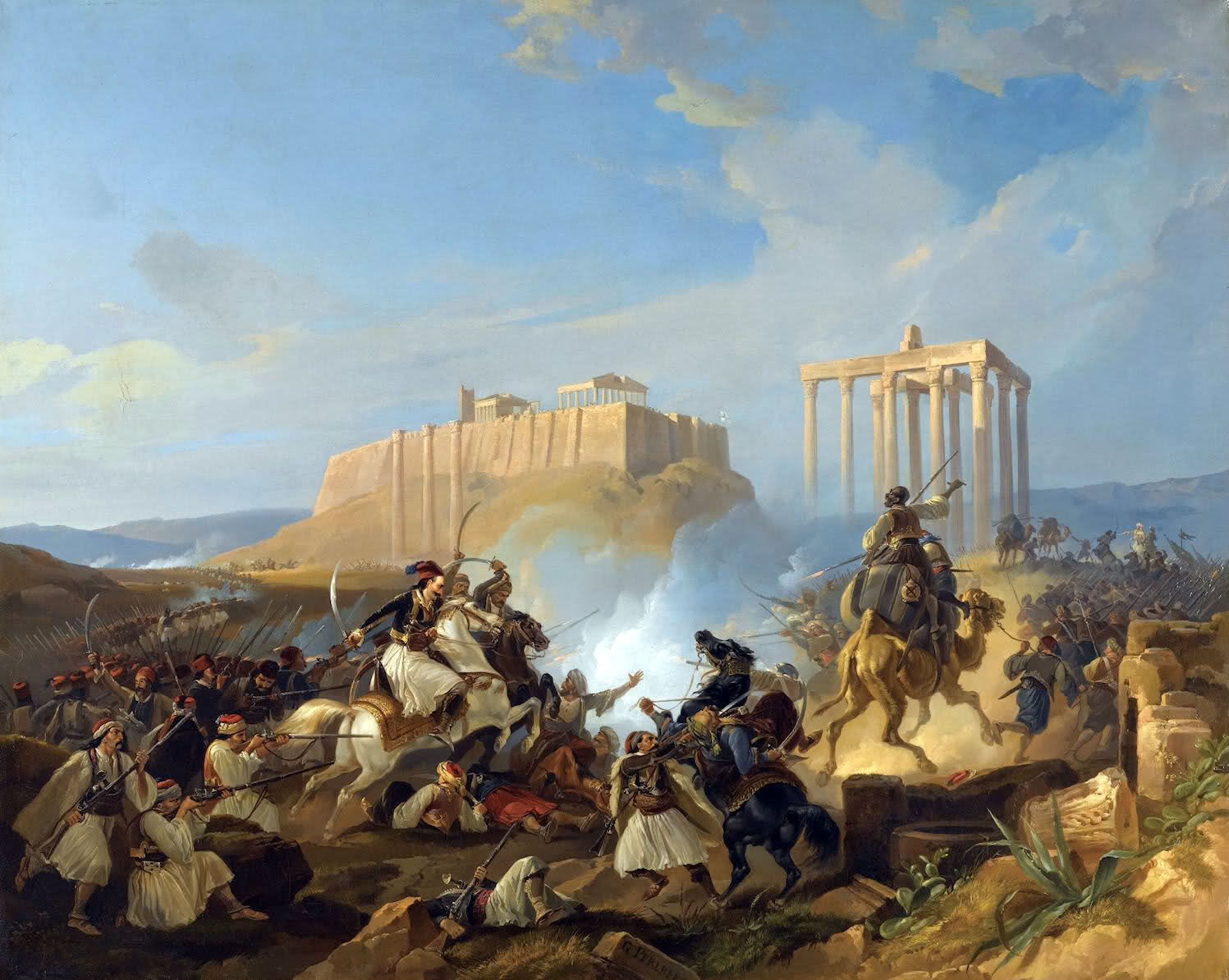
The fighting escalated throughout the mainland and many islands. Using the element of surprise, and aided by Ottoman inefficiency, the Greeks succeeded in taking control of vast areas. Within a year the Greeks had captured the Peloponnese, Athens, and Thebes.

In January 1822 the rebels declared the independence of Greece. The Turks attempted three times between 1822 and 1824 to invade the Peloponnese but were unable to take the area back from the victorious Greeks.

The Ottomans, however, soon recovered and retaliated violently. The retribution drew sympathy for the Greek cause in western Europe, although the British and French governments suspected that the uprising was a Russian plot to seize Greece from the Ottomans.

The Greeks were unable to establish a coherent government and soon fell to fighting among themselves. They lacked unity of objectives and strategy, and the objectives of the different classes and regions were too disparate to be reconciled.

In 1822 two Greek governments existed, and by 1824 open civil war prevailed in Greece. In 1823 civil war broke out between the guerrilla leader Theodoros Kolokotronis and Georgios Kountouriotis, who was head of the government that had been formed in January 1822.

After a second civil war in 1824, Kountouriotis was firmly established as leader. These internal rivalries prevented the Greeks from extending their control and from firmly consolidating their position in the Peloponnese.

Egypt’s Response

Fighting between Greeks and Ottomans continued until 1825, when the sultan asked for help from his most powerful vassal, Egypt. Egypt was then ruled by Muhammad Ali Pasha, who had built up a large army and new naval fleet. The Egyptian force, under the command of Ali’s son Ibrahim, quickly gained control of the seas and Aegean Islands.

With the support of Egyptian sea power, the Ottoman forces successfully invaded the Peloponnese. They recaptured the town of Athens in August 1826, and the Acropolis, symbol of Greece’s former greatness, fell to the Turks in June 1827.

The Western powers were reluctant to intervene, fearing the consequences of creating a power vacuum in southeastern Europe, where the Turks still controlled much territory. In Europe, however, the revolt aroused widespread sympathy.

Greece was viewed as the cradle of Western civilization, and it was lauded by romanticism. The sight of a Christian nation attempting to cast off the rule of a Muslim empire also appealed to the European public.

Help did come from the philhellenes— aristocratic young men, recipients of a classical education, who saw themselves as the inheritors of a glorious civilization, willing to fight to liberate its oppressed descendants.

Philhellenes included Percy Bysshe Shelley, Johann Wolfgang von Goethe, Friedrich Schiller, Victor Hugo, and George Gordon, Lord Byron. Byron spent time in Greece but died from fever in 1824. Byron’s death did even more to augment European sympathy for the Greek cause.

European Intervention

The Greek cause was saved by the intervention of the European powers. Favoring the formation of an autonomous Greek state, they offered to mediate between the Turks and the Greeks in 1826 and 1827.

When the Turks refused, a combined Russian, French, and British fleet destroyed the Turkish-Egyptian fleet in the Bay of Navarino in October 1827. This was the decisive moment in the war, although the British admiral Codrington ruined his career because he had not been ordered to achieve such a victory.

Although the Battle of Navarino severely crippled the Ottoman forces and made the independence of Greece practically certain, another two years passed before the fighting ended and nearly five before the new state took shape. In October 1828 the French landed troops in the Peloponnese to stop the Ottomans.

Under French protection, the Greeks were able to form a new government. In April 1827 Kapodistrias was elected as provisional president of Greece by the third National Assembly. The Greeks then advanced to seize as much territory as possible, including the ancient cities of Athens and Thebes.

Again the Western powers intervened, and Ottoman sultan Mahmud II even proclaimed a holy war. Russia sent troops into the Balkans and engaged the Ottoman army in another Russian-Turkish war in 1828–29.

Fighting continued until 1829, when, with Russian troops at the gates of Constantinople, the sultan accepted Greek independence by the Treaty of Adrianople, or Edirne, in 1829.

In 1830 the Greeks still had in mind a future ruler who would remain the sultan’s vassal. The treaty of Adrianople made this impossible, and in February 1830, the throne of Greece was offered to Prince Leopold of Saxe-Coburg.

In 1832, however, the 17-year-old Bavarian prince Otto from the House of Wittelsbach accepted the Greek throne and became King Otho of the newly independent state. Neither the boundaries nor the constitution of the new Greek state were yet settled, and the state at the time was much smaller than in the present day.

Guangxu (Kuang-hsu)

Guangxu (Kuang-hsu)
Guangxu (Kuang-hsu)

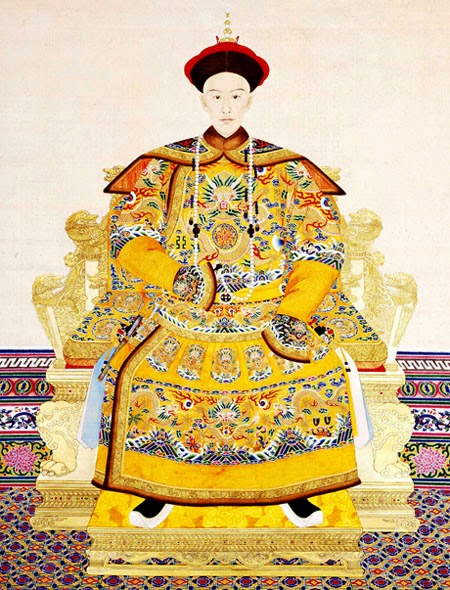
Guangxu’s personal name was Zaitian (Tsai-t’ien). He was born in 1871 and chosen emperor by the dowager empress Cixi (Tz’u-hsi) when her son and his cousin the emperor Tongzhi (T’ung-chih) died without heirs.

His youth ensured another long regency by the ambitious and unscrupulous Cixi. Guangxu was bright and studious, studied English and traditional subjects under able tutors, and grew up to be a man of character and moral convictions.

In 1889 Cixi married him to her niece in order to increase her web of control over him, and though she then formally retired to her luxurious Summer Palace, she continued to dictate policy and make key appointments, leaving Guangxu practically powerless.


China’s catastrophic defeat by Japan in the Sino-Japanese War (1894–1895) convinced Guangxu that dramatic and immediate reforms were needed to save the nation. He therefore supported a group of reformers led by Kang Youwei (K’ang Yu-wei) in 1898 and promulgated laws that would modernize China modeled on Japan’s Meiji Restoration.

He was betrayed to Cixi by General Yuan Shikai (Yuan Shih-k’ai), who struck quickly to imprison Guangxu, crushing the reformers, who were killed, imprisoned, or exiled. In retrospect, Guangxu’s attempt to change China was called the Hundred Days of Reform.

It is believed that Cixi wanted to dethrone or kill Guangxu but was prevented from doing so due to protests by powerful provincial governors and through diplomatic influence of the Western powers.

Cixi’s reactionary rule culminated in the Boxer Rebellion, the besieging of foreign diplomatic compounds in Beijing (Peking) by her supporters, the Boxers, and the capture of the capital by Western relief forces in 1900.

She decided to flee the capital and took the captive emperor with her, murdering his courageous consort Zhen Fei (Chen-fei) for suggesting that he stay behind to negotiate with the Western powers.

When the fugitive Cixi and the court returned to Beijing in 1902 after the settlement of the Boxer fiasco, she made Guangxu take the blame for what had happened.

Guangxu endured his imprisonment with patience, reading and preparing for the day when he would be free to rule after his adoptive mother died. She died from illness on November 15, 1908, at 73, at which time the palace announced that he had suddenly died on the previous day at age 37.

It is widely believed that he died an unnatural death at the hands of her supporters, with or without her consent. Thus ended the tragic life of Emperor Guangxu, who could never escape the control of his vicious aunt/adoptive mother.

Before her death Cixi had named her infant great-nephew successor of the childless Guangxu. The boy ruled as Emperor Xuantong (Hsuan-tung) between 1909–11; he was the last emperor of the Qing dynasty.

Haitian Revolution

Haitian Revolution
Haitian Revolution

The Haitian Revolution represents one of the signal events of the age of revolution, reverberating across the Atlantic world and profoundly shaping social and political relations across the Western Hemisphere in the decades after its eruption in 1791.

The only successful large-scale slave revolt in the history of the Americas, the revolution in Haiti served as a cautionary tale for slave owners across the Americas, prompting a tightening of slave regimes and of slave surveillance and control measures from Canada and the United States to Brazil and Peru.

Despite the profundity of its impact, however, the Haitian Revolution also has tended not to receive the attention it merits—partly because the French-controlled western portion of the island of Hispaniola, as a colony of neither the Spanish, Portuguese, nor British, fell outside the purview of accounts of these empires’ histories (and has been conventionally excluded, for instance, from treatments of both the U.S. and Latin American independence periods), partly, in the view of some, because of the racism inherent in conventional historical accounts of this era.


The events of the revolution itself are dizzyingly complex and difficult to summarize. On the eve of the revolution, the French colony of Saint-Domingue, vaunted as the Pearl of the Antilles, was the largest sugar-producing region in the world, outpacing even Brazil, the world’s second-largest, its 800 sugarcane plantations producing more sugar than all of the British West Indies combined.

In the decade before 1789 Saint-Domingue’s slave imports averaged 30,000 per year. Its population was divided into three caste-like strata. At the bottom roughly half a million black slaves, comprising 85–90 percent of the population.

At the top were 40,000 whites, divided between a tiny number of large plantation owners and wealthy merchants, or grands blancs, and the vast majority of poor and middling whites, the petits blancs, who deeply resented the former. In between were some 28,000 free people of color (gens de couleur, or affranchis, principally mulatto and some black).

Despite Louis XIV’s Code Noir of 1685, making mulattos and free blacks subjects of the French empire, the rights of the gens de couleur were restricted by a series of laws meant to protect the superior social position of whites.

With the onset of the French Revolution in 1789, the revolutionary ideals of liberty, equality, and fraternity essentially percolated down the social hierarchy, from whites to free coloreds to black slaves.

As the grand blancs sought autonomy from the French government, Saint-Domingue’s free coloreds, via the influential Paris-based, mulatto-dominated Société des Amis des Noirs (Society of Friends of the Blacks) sought equal representation in the Estates General in Paris. Rebuffed, in October 1790 several free colored leaders led an abortive uprising.

By this time, the colony had entered a period of revolutionary turmoil, with debates about liberty and rights resounding throughout its towns and streets. Neither whites nor free coloreds contemplated liberty for slaves, though neither could prevent their slaves from hearing or acting on these debates.

In August 1791 after a period of secretive organizing, the slaves launched their uprising, burning cane fields across the western part of the island—an uprising that lasted more than a decade, and that ultimately led to the independence of Haiti on January 1, 1804.

After August 1791, confronted with the specter of a slave revolt, whites and free coloreds temporarily closed ranks, though the animosities between the two groups proved too great to bridge.

The slave rising spread into the eastern part of the island, nominally controlled by the Spanish. On March 4, 1792, the French revolutionary government granted equality between whites and free coloreds, a decree that did not stop the island’s slide into civil war.

The British, courted by the grand blancs and hoping to exploit the opportunity to weaken their French rival, invaded parts of the west, while the Spanish, hoping to regain control of the west, marched from the east.

The conflict thus combined a civil war among and between the island’s fractious whites and free coloreds, an international war pitting France, Britain, and Spain, and a slave uprising against them all. In the end, a small group of the most prominent ex-slave leaders emerged victorious.

A pivotal event in this process occurred on April 29, 1793, when Leger-Félicité Sonthonax, a Jacobin high commissioner sent by the French government to restore order, exceeded his authority by abolishing slavery throughout the island.

The decision permitted a temporary alliance between the French and slave rebels against the British and Spanish, while also catapulting into prominence former house slave Toussaint Louverture, who became commander of the French forces and the undisputed leader of the ex-slave rebels.

After five years and the loss of more than 25,000 troops, the British were defeated, departing the island in April 1798. Soon after, in February 1799, mulattos under André Rigaud rebelled against Toussaint, sparking another civil war.

Toussaint’s forces crushed the rebellion by August 1800. Meanwhile Toussaint, Saint-Domingue’s governor-general and commander in chief, established relations with the United States and promulgated a series of laws intended to maintain sugar production and a semblance of social order.

Back in France, Napoleon determined to regain the island. Invading in January and February 1802, French forces captured Toussaint in June. He was transported in chains back to France, where he died the next year.

Leadership of the black-mulatto forces fell to Toussaint’s lieutenant Jean-Jacques Dessalines. For the next 21 months some 58,000 French forces fought against Dessalines’s army.

They were defeated at the cost of some 50,000 French lives, most dying of yellow fever, and in January 1804, the independent nation-state of Haiti (an indigenous name for the island) came into being.

Abdul Hamid II

Abdul Hamid II
Abdul Hamid II

Abdul Hamid II, who reigned 1876–1909, became sultan after his brother, Sultan Murad V, was deposed because of mental illness. He came to power by promising reforms and support for a constitution, but he soon reasserted the sultan’s traditional authoritarian powers.

At the time, the Ottoman Empire was beset with problems. The empire was deeply in debt, nationalist rebellions had broken out in Bosnia and Bulgaria, war raged in Serbia and Montenegro, and Russia threatened to further its expansion into Ottoman territories.

However, the promulgation of a constitution and establishment of a parliament in 1877 seemed to promise new reforms that would perhaps revive the empire’s former strength.


The constitution, drawn up by the able administrator and reformer Midhat Pasha, was shortlived, as Abdul Hamid II used the 1877 war with Russia as the excuse to disband parliament and suspend the constitution. He then removed Midhat from power and sent him into exile.

Abdul Hamid II hired German advisers to rebuild the army and administer the finances. To the dismay of the British, German influence within the empire increased steadily until World War I.

Abdul Hamid II turned a blind eye to the British occupation of Egypt, although ostensibly Egypt remained part of the Ottoman Empire, it became a de facto part of the British Empire ruled by British “advisers.”

Abdul Hamid II limited the power of government bureaucrats and concentrated power within the sultanate. He also established strict censorship over publications and monitored political activities through a network of secret agents.

Although most of his predecessors had paid scant attention to their title as caliph, Abdul Hamid II reemphasized his role as caliph and protector of the Muslim world.

Abdul Hamid II vainly attempted to use the appeal of the pan-Islamic movement, popularized by Jamal al-Din al-Afghani, to counter the growing nationalism within the diverse Ottoman Empire. The construction of the Hijaz railway to facilitate the pilgrimage to Mecca and Medina was part of his campaign to foster Islamic support.

Abdul Hamid II also rejected the Zionist offer made by Theodor Herzl to pay a portion of the huge Ottoman debt in exchange for an Ottoman charter allowing Zionist colonization of Palestine.

Herzl was told that the sultan was not in the business of “cutting off his arm,” meaning that Palestine was considered an integral part of the empire, but that Jews were welcome to live there.

Fearing assassination, he made himself a virtual prisoner in the palace of Yildiz. Abdul Hamid’s authoritarian rule increased discontent within the military. As a result, the Young Turks, dominated by army officers, took over the government in 1908.

Abdul Hamid II was forced to accept the reinstitution of the 1876 constitution. In 1909 he abdicated in favor of his brother, who became Sultan Muhammad V. Abdul Hamid II spent his last years under house arrest at the Beylerbeyi Palace in Istanbul, where he died in 1918.

Alexander Hamilton

Alexander Hamilton
Alexander Hamilton
Born in the British West Indies to parents who were not legally married, Alexander Hamilton surmounted his origins, becoming a wartime aide to General George Washington, a key theorist and promoter of the U.S. Constitution, and the creator of a bold financial system for the new republic. Prideful and outspoken, Hamilton died at the hands of Vice President Aaron Burr in a politically motivated illegal duel in July 1804.

Motherless by age 12 and estranged from his father, Hamilton trained as a clerk on the sugar island of St. Croix. There, the self-taught young man dabbled in poetry, penned an eyewitness account of a devastating 1772 hurricane, and so impressed Presbyterian minister Hugh Knox that the older man took up a collection to send his protégé to college in New York. Mentorship by important older men would become a pattern in Hamilton’s career.

Caught up in the growing revolutionary fervor, Hamilton soon became a pamphleteer and, by 1776, captained an artillery company. Noticed by Washington, Hamilton became the general’s trusted aide-de-camp.

Marriage in 1780 to Elizabeth Schuyler, daughter of a wealthy and politically influential Albany landowner, and a temporary falling out with Washington resulted in Hamilton’s returning to Albany, where he studied law alongside Aaron Burr, another young and ambitious New Yorker. Hamilton resumed pamphleteering on urgent issues of governance, taxation, and finance.


He found time to cofound the Bank of New York and an antislavery society, although his father-in-law owned slaves. In 1782 as a delegate to the congress crafting the Articles of Confederation, Hamilton began an intellectual partnership with a promising young Virginian, James Madison.

An early proponent of a stronger and more centralized government to replace the faltering Articles, Hamilton was New York’s sole delegate to the Constitutional Convention of 1787. As “Publius,” he, along with Madison and John Jay, wrote a series of arguments for ratification, later collected as the Federalist Papers.

Controversial Economics

In September 1789 Hamilton became George Washington’s and the nation’s first secretary of the treasury. Audaciously, Hamilton proposed a controversial economic plan based in part on the ideas of pioneering British economist Adam Smith. Many of Hamilton’s ideas contradicted much of his era’s traditional financial wisdom and religious teachings.

His proposals included consolidation of state liabilities into a permanent federal debt, a national bank controlled by a public/private partnership that could manipulate the nation’s money supply, and luxury taxes on such goods as tea and whiskey. Hamilton also urged Congress to use federal funds and impose tariffs to promote manufacturing and America’s role in the emerging Industrial Revolution.

Hamilton soon found himself at odds with former ally Madison and secretary of state Thomas Jefferson, both slave-owning Virginians who had a very different vision of the new nation, based primarily on the expansion of agriculture.

Nevertheless, major portions of Hamilton’s economic plan were adopted after Jefferson brokered an agreement creating a federal capital district on the Potomac between Maryland and Virginia, rather than New York, Hamilton’s preference. Hamilton’s F1rst Bank of the United States was chartered in 1791, and the U.S. Mint approved in 1792.

Although Hamilton was personally involved in the creation of one of America’s first water-powered industrial cities, Paterson, New Jersey, most of his “Report on Manufactures” failed to win congressional approval.

At the height of his power and influence, Hamilton became entangled in a web of personal and financial misadventures that would cast a shadow over his career. Although generally regarded as personally honest, he did not always use good judgment in picking close friends and assistants.

Some used insider information to speculate on currency fluctuations and otherwise enrich themselves. One key aide, William Duer, not only took financial advantage of his connection with the treasury secretary but also introduced Hamilton to Maria Reynolds, a married woman.

Their ensuing affair, apparently abetted by Mrs. Reynolds’s husband for purposes of blackmail, continued for more than a year and ended with Hamilton’s embarrassing confession, publicly revealed in 1797.

As the French Revolution took a turn into violence, political differences between cabinet colleagues Hamilton and Jefferson intensified as Jefferson hailed the end of French monarchy while Hamilton abhorred turmoil in the United States’s old ally.

Alexander Hamilton statue

In 1794, when Pennsylvania farmers rebelled against Hamilton’s whiskey tax, the treasury secretary persuaded President Washington to use troops to quell the uprising by raising the specter of anarchy akin to recent events in France.

Hamilton rode into battle alongside his general. The next year, Hamilton resigned his cabinet post to resume a lucrative law practice. He would in 1796 help Washington write his farewell address.

John Adams of Massachusetts and Hamilton were part of the new Federalist Party by the time of America’s first contested presidential election in 1796, but they were not friends.

Unable to derail Adams’s presidential candidacy, Hamilton played a supportive role by questioning the character of Jefferson, a leader of the new Democratic-Republican Party. Hamilton also founded a newspaper, the New-York Evening Post, as a mouthpiece for Federalist politics and his own New York ambitions.

The Duel

The election of 1800 deadlocked, with Jefferson and Burr, both Republicans, each receiving 73 electoral votes. Into this procedural mess (later corrected by the Constitution’s 12th Amendment) waded Hamilton. Despite their political differences, Jefferson and Hamilton were major figures, founders of the republic.

By contrast, Hamilton argued as he urged the electors to pick Jefferson, Burr was an opportunist of questionable character. Burr became Jefferson’s vice president; the uneasily competitive Burr-Hamilton relationship became loathing on both sides.

Against a backdrop of vicious New York political maneuvering, Burr and Hamilton squared off at dawn on a Weehawken, New Jersey, bluff overlooking Manhattan. Both fired; Burr’s bullet tore through Hamilton’s liver. A day later, Hamilton was dead.

Burr, never even tried for illegal dueling, resumed his seat as president of the Senate in the next congressional session. Elizabeth Hamilton would outlive her husband by 50 years. She was buried alongside him in Trinity Churchyard near Wall Street, America’s financial heart.